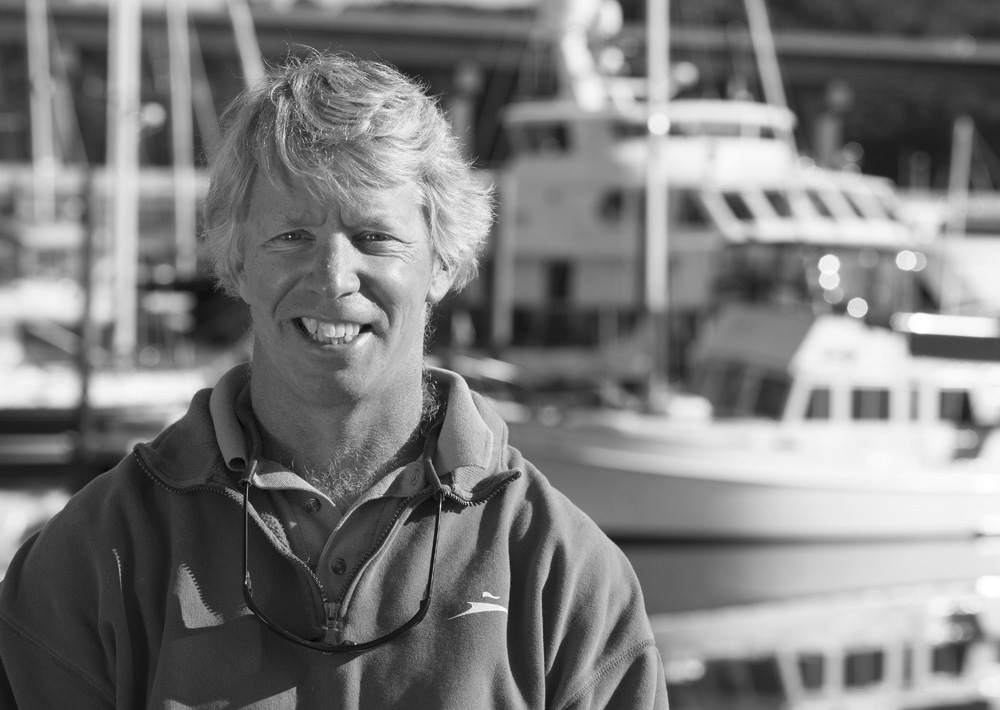
BELFAST – There are a number of very high-profile boat yards on the coast of Maine and each of them are headed by a dynamic individual. Running a boat yard is not a simple endeavour. You never know from one day to the next what you will be confronted with. It is very challenging and knowledge of all aspects of the yard, coupled with knowing the hurdles and pit falls of business can help you navigate around a potential disaster.
One, if not the most successful individuals running a high-profile yard here in the State of Maine is J. B. Turner of Front Street Shipyard in Belfast.
JB grew up in Noank, Connecticut. He said, “It is not a well-known little town. It is an old fishing village at the mouth of Mystic River. I had a great time growing up. It was one of those older family things where you come home from school, cross the bridge and then the whole town is yours because there is only one way in and one way out. So, when the whistle blew at 6:00 you’d go home for supper and if you are not there by 6:15, you didn’t eat.”
JB’s father had several different boats while he was growing up. JB added, “He grew up sailing, the first one of the family. Both my grandparents weren’t into boating at all. They lived in Mystic and Noank as well but weren’t into it. My father took to lobstering and sailing especially. I started with an S-boat, in the 60s. After that we got a family cruising powerboat for a couple of years. That almost blew up a couple of times because it had big gas engines that were dangerous. Then we bought a C & C 31 and sailed on that as a family for five or six years. My father always named boats after birds. I grew up sailing Beetle cats. We had two of them. The Mystic River Beetlecat Association, my father was part of that, so we raced Beetle cats. We went to the shop when I was a kid. My father took us up to Cape Cod and we met with them and they showed us how they were building them. It was interesting. There were only a couple people who worked in the shop. As a kid, oh, this is cool.’ I will never forget going to that shop.”
While JB was going up in the Mystic area there was still several small boatbuilding shops as well as lobstering. JB recounted, “There was a lot of lobstering back then. My neighbor was one of the biggest lobstermen in Connecticut and he ran a bunch of boats. My brother worked for him, I never did. We used to go down and watch them build the pots in the winter and sometimes I would help nail a few things. I always built pots with my father. He had a 25-pot license, so we built pots, anything to keep my brothers and I out of the house.”
The Turners lived in West Cove, which is on the other side of the peninsula from the Mystic River. JB added, “My father would fish around Fisher’s Island, and we’d run around picking up a few pots. He would take the meat and sell it and get enough to buy steak, which he and I would eat. My mom and my other brother would eat lobster.”
JB got into the marine business during summer vacations from college. He said, “I went to Bryant College for business management and during the summers I was helping run a charter boat business. We ran 25 boats and basically it was myself and this kid I called “the rat,” who cleaned them. It was pretty successful, but it was a lot of work. I learned a ton doing it, because basically the boat yard [Dodson Boat Yard, Stonington] said, ‘we are not going to help you.” We have got too much going on, so when boats break, you have got to figure it out yourself kid.’ So, I had to. Advice was free, but don’t ask too many times.”
After graduating from college in 1986, JB continued running the charter business that summer. During that time Bob Synder of Dodson Boat Yard asked if he wanted to come to work for them. At that point, it was either managing Cumberland Farms or managing a boat yard,” said JB. “I would take the boat yard, every day of the week. I quickly moved into the yard and was assistant yard manager under Bob for a while. That first winter Bob had a stroke, so he decided to take his family west and recover. They were like, ‘See you later, the boat yard is yours.” Good luck.’ His brother Matt helped me because he was really good with the mechanic side. That was trial by fire. I went from running a 25-boat charter business to running a boat yard with 35 employees and storing 140 boats. Bob came back, but I just kept running the yard. Bob still runs it to this day.”
JB was there eight years, but he was looking to work on bigger boats and thought to do this he should come to Maine. He had been to Maine, but only on a New York Yacht Club cruise with a customer. He said, “I thought it was always low tide and foggy. Why did anybody live here? You can’t see land and there was always mud. But I wanted to work on bigger boats with bigger systems and learn more about that end of the world. I was married at the time, we just had my daughter, and we came up and stayed at the Inn at Camden Hills. I said to my wife, as I always do, “I am just going to go down to the boat yard and see what is going on.” I went down to Wayfarer and I met Stuart Farnham and chatted with him for a while and he hooked me up with Michael Mahan, who was the president at the time. We chatted for another hour or so and by the end of the day, they said they would hire me as service manager.”
JB returned to Dodson and made sure the customer’s transition to a new service manager went well. In the spring of 1994, he moved to Maine and started at Wayfarer Marine. “I took on the bigger boats because I wanted to learn more,” said JB. “Wilson Darling and I were best friends and got along great. We were the two service managers, we split everything up and it was a good time, but it was a lot of work, 60-to-80-hour work weeks, every week. I learned more things about bigger boats, systems, different types of boats and building materials aluminum, steel, fiberglass. Then we got into some potential building. One of my favorite stories is they asked me to go over to Able’s and check it out. I went over and went crawling around in the bilge, thinking this is impossible, this is nuts. We never did build a boat, but we rebuilt a lot. It was really busy back then it was crazy busy, which was good. You learned a lot.”
In 1998 Stuart Farnham was now with Lyman-Morse in Thomaston and he gave JB a call saying they were thinking about building boats. “At that point it was the fall, I was completely burned out from all of the major refits we have been working on,” explained JB. “I met with Cabot, who I had never met before, and just started conversations back and forth for a month or so. The whole idea was that he wanted to go sailing. So, I would run the yard, and he would go sail the Pacific.”
JB was at Lyman-Morse for 11½ years. During that time, they built 34 boats ranging in size from 30 to 94 feet, sail and power, fiberglass, or aluminum. JB added, “We could do anything at that time. We got up to 200 people. At one point, we had seven different designers working on seven different custom boats. Two hundred people were too many, 150 worked pretty good. I always focused on the boatbuilding side, the service side kind of ran itself. We had so many people that we actually drove the overhead costs down and then the service side could make a lot of money. The overhead was all being covered by the boatbuilding side. That was good.
“We built a whole bunch,” continued JB, “but it wasn’t so much the boats, the people were always the interesting part. One of our most important boats probably was MAGPIE, which was a 74-footer power boat, Ward Setzer design. That was a change for Lyman-Morse from the standard interiors and systems to top-end world class joinery with high-end finishes. My part was that I could, like my grandfather who was an artist, I can see the whole thing, finished with all the colours when somebody talks to me about something. When we built MAGPIE, I was sitting in the main salon in the companionway just looking out and the owner would be talking to me and I said, ‘I got it, I know exactly what you want to do,’ and then between myself and a couple of others we put the pieces all together. That was an important change for Lyman-Morse to bring it up to world-class. We kept that going for a long time.”
When The Hinckley Company began building the 36-foot jet boat and everyone had to have one no matter who built it, Lyman-Morse joined the fray. They built a number of 30-foot jet boats. JB found them a fun project. He added, “The first two boats I was involved in was WIND WALKER, which is a 60-foot Hood. I think it was the last design that Ted Hood himself did. The other was NIGHT HAWK, which is a 55-foot S&S power boat. They were a huge learning curve for me. Luckily, the guys at the yard spent a lot of time with me and that is where I really picked up the composite side.
“We SCRIMPed all the boats” said JB, “and I was pouring resin and turning lines on. Because I grew up in a service yard I think you really don’t understand how the laminates work. When you get into the boatbuilding side, you really have to understand where the structure is and how it spreads the loads. That was really something I started learning back at Dodson. One of the great carpenters down there, Bill Mills, would spend time with me. We would sit down and he would explain how this is the triangle that’s created, and this is where strength comes from and this is where the load goes. I was like a little sponge and that was cool.”
One of JB’s customers while at Lyman-Morse was Burt Keenan, who built an 84-footer ACADIA at Lyman-Morse. JB added, “He was a character and was involved in the original group building Front Street. He was from Louisiana and he had some great stories. He and I talked on the phone every day except Sunday for two years, every day. We got to be really good friends obviously. He had built a cat ketch with Cabot years before that and then he built the 84-footer with me. You just kind of build a lot of relationships. Boats are one thing, but the relationships are more fun in a way. I was fortunate to have a really good group of people build custom boats that knew what they wanted, for the most part. We’d become friends, all of them except one. One out of 84, that is not so bad.”
JB would leave Lyman-Morse and end up at Ken-Way in Augusta. He explained, “I went to Kenway for a whole year. I called Ken [Priest, head of Ken-Way] and I asked him if he would be interested in talking with me about a job. Met him for lunch, I think it was Panera Bread in Augusta. We chatted for a while and he said, ‘Yeah I think I’ve got a spot for you.’ I got involved in some of those weird projects like the building a completely composite wind machine. The understanding of how the structure all works I learned at Lyman-Morse. When I started with Ken, we were building skiffs and the way they were infusing my heart stopped the first time I watched them. They opened all of the lines all at once, I was like, ‘Oh my god, this is horrible. What are you doing?’ Of course, they had dry spots because they opened all the lines at once. They said, ‘Yeah, it happens every time.’ ‘Well, don’t do it that way. You SCRIMP it. You open one line, then you go to the next line and then the next and it works every single time perfectly. So, I went up there for a year.”
I remember being at a Maine Boatbuilder’s Show and the discussion was about JB and where was he going to end up. We knew he was at Kenway, but we figured that would not be the final landing site. He added, “How Front Street all came about was actually because of Maine Marine Trades. I was on the board, Steve White was on the board at time, and we went out to lunch afterwards. We started talking about the fact that there was some land available down in Belfast and said, ‘Well, why don’t we get together and take a look at it.’ So, we got together the next day and walked the land and got pretty excited about how flat it was, not about anything else about it, but how flat it was and it had deep water. Steve called his brother-in-law Taylor Allen and said, ‘Do you want to take a look at this with us, it looks pretty interesting. So, we all walked around again, and we all got pretty excited about it. The city actually helped us the most in the very beginning because the current owners were trying to turn it into condos and it was a mess. The city realized it was a mess and there were covenants that were made by the group that were being broken left and right. So, the city helped us start litigation against the condo owners to help them decide to negotiate. I was still working at Kenway and about two months into it I went into Ken’s office and said, ‘Let me tell you what’s going on.” We are looking at buying this land and we are thinking about starting a boat yard. I didn’t even finish my explanation, he’s like, ‘Stop, I want in.’ So, Ken was on board. Then, Lucia, who is Taylor’s sister, joined. Then at the very end, Burt Keenan had a friend who was selling his company and Burt called him and said, ‘I think you are going to have to help these guys.’ Nobody says no to Burt, and he became a partner with us. Our investor was a huge key to our success. The banks were like, ‘We’ll give you a couple hundred thousand dollars.’ Well, that buys six pilings, but we need 600. Jack set up a loan structure, and his deal was that in three years, he wanted out and he wanted the bank to take over. So, we built everything and after 3½ years he left.”
For those that do not remember, when this group took possession there were several buildings from the sardine factory and the partial beginning structure for the condos. JB explained, “When we started, our agreement with the city was we had to tear down what was left of the sardine/condo mess. That did not take long. Literally an excavator came in and touched the deck and the whole thing just collapsed. Building 2, that was where the freezer plate was, and that is now part of the dock system. We thought and thought on how to save it and we just couldn’t, it was too far gone. What is now building 3 was where they made the sardine cans, that had collapsed in on itself. So, that was another inspiring walk-through. What we call building 4A now, was their loading dock. Building 4 was really the one building that was worth anything. That was the last building the sardine factory built and that is where they stored the sardines. Building 5 and 6 were over railroad land. So, when we started, we really had building 4 and a shack that I bought. That shack [originally their office] we cut it in half and made it into a dock house. Then we just hired every contractor we could come up with to rebuild the whole place. What you see now didn’t happen over 10 years, it was a year other than building 6. We built number 5 in 2011, the same time as we were rebuilding 3, 4, 4a.”
STONEFACE was the first big project. “That was just happenstance,” continued JB. “We were sitting down here in the shack and a guy walked in wearing a nice shirt and shorts and said, ‘Would you be interested in rebuilding a 106-foot Burger?’ ‘Sure.’ ‘So, where would you do that?’ I said, ‘Well, come out with me and we walked out and I said, ‘Picture a building over here, a big one.” I said if you bring your boat up here, we will build a building. We went down to New Jersey and looked at STONEFACE, and it was a wreck. I was looking around the boat going ‘I don’t think you can make it to Maine.’ He kept his word, they arrived in November, we kept our word, we built the building from basically July to December, Number 5. We moved the boat in, there was still no power for the first couple weeks, but she was inside. We started to take her apart and grow the workforce from, I think we had 10 employees in July to 115 by February. STONEFACE turned into a complete rebuild and she left in January 2012.”
The owner of STONEFACE was so happy with the job he returned with another one of his boats, a steel fishing trawler, SINBAD, and they rebuilt her.
One major plus was that when Front Street Shipyard needed employees, JB just had to put the word out and many who had worked with him in the past would come and join the team. Because they were experienced, they could go to work with little to no supervision.
Another interesting hurdle JB and the other owners had to overcome was as the boats got bigger it was quickly evident that the 150-ton Travelift was not big enough. They looked around at other yards, but the one they watched mostly was Newport Shipyard in Newport, Rhode Island. They had been looking at a 330-ton lift but ended up with a 500-ton lift. JB said, “That was probably the most our ownership group debated. I decided we didn’t really need 500, so we ended up with 440. I happened to be down at the Fort Lauderdale Boat Show and Derecktor’s lift was coming online with their 900-ton machine. I left the show and went over to see Derecktor’s and talked with them. They said Cimolai because they are just really easy to work with. Monday, I called them, and by Friday we ordered the machine. That was huge. It brought us more work, huge refits and certainly paid for itself.”
I have stated in Boat Yard News that I could go to Front Street Shipyard every month and still have new Boat Yard news to report on. They currently have about 100 employees, which are needed to keep everything moving. They always have several rebuilds, a couple of new builds and then their storage customers for regular annual maintenance. Then there are those transients that come for work or just to spend a day or more on the dock during the summer. Presently, they have several rebuilds, a naval project, a new build underway, and the annual maintenance on all the storage boats. There is talk about carbon fiber water taxi and they are always looking for the next big refit. You never know when the phone is going to ring next, but because they, JB and the yard, have an excellent reputation that will always keep the phone ringing.
This interview was done for a Maine Built Boat film, which you can find online in its entirety at: mainebuiltboats.com/jb-turner/