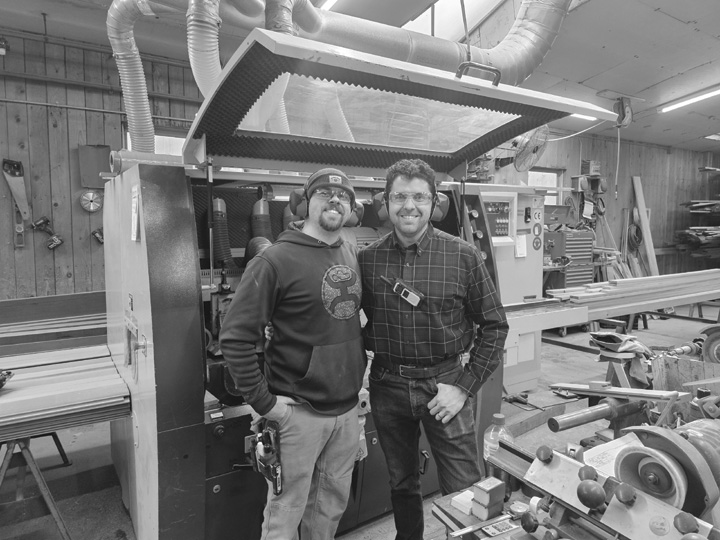
Zach and Ken Boothby, along with their father, are the new owners of Americas’ Wood Company in Washington.
WASHINGTON, ME – There are always changes whether we like it or not. I have always thought that the changes along the coast have been slow, but recently that does not seem to be the case as numerous companies have changed hands over the last several years. Of course, the big news was Front Street Shipyard becoming part of Safe Harbors, but if you are in the world of wood the sale of Americas’ Wood Company is also big news. Rich Simon, who started the company, recently finalized the sale to Ken Boothby, his brother Zach, along with their father mid-winter.
When asked how this all came about, Ken explained, “My family has a long history in Maine. I would’ve been a 13th generation Mainer, but I was the first generation in my family born out of state. My brother and I were both born in Texas but came to Maine every year as kids growing up. We also lived here for a few years in elementary school in between moving around the world with my dad’s career. He was in oil and gas and I was too. I followed in his footsteps out of college. I got my petroleum engineering degree and drilled wells all over the lower 48 and the Gulf of Mexico. I then ended up going and getting my MBA at Rice University. I did that full-time for two years and I like to tell everybody that’s where my brain kind of got rotten. I started to realize there are always other things that you could do, and I had always had this weird dream about returning the family to Maine and having our kids grow up here and being part of the community.
“While I was at Rice, I stumbled into a couple of these courses on enterprise acquisition where they teach young MBA students about the possibilities of buying middle-market businesses from folks that are retiring,” continued Ken. “Things that are maybe a little small for private equity to look at, but big enough that there’s at least a little gravity to them. That idea kind of stuck with me and at the same time I was doing some coursework, kind of a Capstone project on starting a company from scratch. This is almost 10 years ago, and everybody wanted to do an app. So, there’s ten teams and nine of them were the latest and greatest app. There was one really weird team that I ran that wanted to resurrect a defunct wooden boat brand in the State of Maine. My family had always collected old wooden canoes, wooden boats and we had a couple watercraft from a company called Sebago Boat and Canoe Company and they were built in the town that my family is from originally, over in Sebago. I have always loved those boats. I got it in my head that wouldn’t it be cool. You see some of these Western Maine towns where the economic engine was ripped out. Seeing some of the defunct mills having a really cool resurrection story and a new manufacturing story. The idea was so popular that initially it was kind of a running joke in the class. I had all of these nine teams laughing at me. We would give our weekly update, and everyone would go through their app and then the wooden boat guy would get up to give his spiel. A few weeks in, everybody was kind of over the apps and all they wanted to hear about was how the wooden boat team was doing.”
What Ken learned was how hard it was to start a company in the State of Maine. He also discovered that true boat people simply love boats, no matter what.
At the end of the course, they pitched their idea to angel investors. Ken added, “I get to the end of my presentation and one of them says, ‘Are you going to do this?’ I said, ‘I might, but I do have a job offer lined up right now.’ He says, ‘Well, your excitement is palpable and you shouldn’t lose that.’ That always stuck with me. Maybe this resonated beyond just what was economically sensible, but there is an element to the boating world, the manufacturing story, and the story of a resurrection that really excited people, it excited my team, it excited my classmates and it excited this wealthy group of investors.”
Ken went back to the world of corporate planning. “One thing I took away from all of my research was that it was going to be really difficult to start a business in Maine,” said Ken. “Anything new that gets started you are kind of up against it in regards to regulatory and taxation. The mills that we were looking at repurchasing had all sorts of red tape and paperwork from the regulatory agencies just to get into the initial conversation about what we could do with the property. I needed to find a business that survived in spite of the challenging environment and thrived. As I started peeling the onion I found a lot of great businesses with a lot of great people that in spite of the challenges had weathered the storm with compelling growth trajectories. I was at this crossroads in my career. Do you re-up and go heavier into the white-collar corporate planning world or do you really tackle something that excites you? My wife said, ‘You aren’t going to be happy unless you try.’ So, I started hunting. I looked for companies in Texas and Maine, but I kept coming back to Maine in spite of all of the challenges. So, I kept hunting and I realized that there are a lot of deals that are hiding off market. One of the Portland brokers mentioned a really interesting guy with a really interesting company that might want to talk to me, but his business isn’t listed. He hadn’t decided if he wanted to sell. I said, ‘Give him my number and we will see.’ The next day the broker called and said, “Okay, he might talk to you, but you need to write an essay explaining why a guy from Texas might want to come up here and take over a wood company.’ I said, ‘That’s fair, I would probably be curious if I was him too.” So, I wrote a paper and explained the family history and the story I just gave you and it was compelling enough, he picked up the phone. We started talking and he explained the business, but he wouldn’t tell me what the business did. He wouldn’t tell me who the customers were. He just said, ‘We sell high-end wood and it’s a good business.’ It has a lot to do with boats and that kind of tripped my radar. So, we flew up here and met him, sat down in this room, and talked for a while and then he started as we worked through things to tell me who the core customer base was. You are dealing with guys like Pete Kass at John’s Bay Boat, Hinckley, Brooklin Boat Yard, Rockport Marine and so on. To me it’s the last bastion of real American craftsmanship. I think there’s so much in life today that is coated with a veneer of quality. It is designed to give the allure of quality, but it’s not real. You can’t fake what these guys do. Every day we are interacting with them and getting to send material to be part of what I view as the most beautiful boats in the world. I could have this amazing opportunity and help in many of these projects and be part of that community. That has been wildly cool. They have been beyond welcoming, beyond understanding.”
The main aspect of this business is to supply the highest quality of wood to the high-end craftsmen of the state, especially the boatbuilders. They have calls come in from all over the United States the West Indies and up into Canada. Ken stated, “Americas’ Wood is never going to be Home Depot or mass market. It is not what I want, it certainly wasn’t what Rich wanted.
“My brother and I were sitting at this table after we bought the company and were trying to reinvent the tag line,” said Ken, “how would you describe the company? We came up with ‘Fine Wood for Discerning Craftsmen’ and there’s no more discerning craftsmen than yacht builders. I think it puts this brand in a unique place where you are defending that commodity more than trying to push the commodity.”
Ken came to respect Rich for what he had accomplished. He said, “He built all of this from scratch out of a couple 18-wheeler bodies he would sell wood out of. Rich would never sacrifice what he viewed as the best use of the wood. He wasn’t going to give it to somebody that didn’t deserve it. I think it was the defense of the resource. That is a unique position, and it creates the ethos of what Americas’ Wood is. It is a privilege to do business here, not because of who we are, but because it puts you in the realm of all these other craftsmen that call this place home and call this industry home. For the industry to continue to prosper you have got to make sure that it is going to people that need it. It is not a place for hobbyists; it is not a retail facility.”
When you drive by the company there is no sign on the road. There is a small one on the first building, which will tell you the name of the company and that they only sell wholesale. They have talked about a retail store, but they do not see that in their future. They are happy to try and help people get what they need, but their first commitment is to the high-end craftsmen. They have talked about putting pre-milled packages together and that might happen at some point.
Ken added, “I think anything we do will be a measured approach and it is not going to be with the idea of moving as much product as possible. If anything, it will be trying to encourage younger groups of craftsmen and people that may not know this resource is here. I think we are opening aperture to the home building community. Americas’ Wood has always been very selective about dealing with high-end home builders. It seems like a lot of the folks that appreciate fine boats, appreciate fine homes and there is a little bit of overlap in that world. We are interested in talking to more of those folks.”
Ken feels that one thing Maine has done really well, is keeping the identity of craftsmanship. He said, “I have been coming to Maine all my life, and the mid-coast boatbuilding industry in Maine is incredible. That story of home builders we work with is incredible. The cabinet makers we work with are incredible. If we can help tell that story we might be able to drive more activity to them. The things we make are going to be really good. We are not here to compete in mass. We are here to compete on quality.”