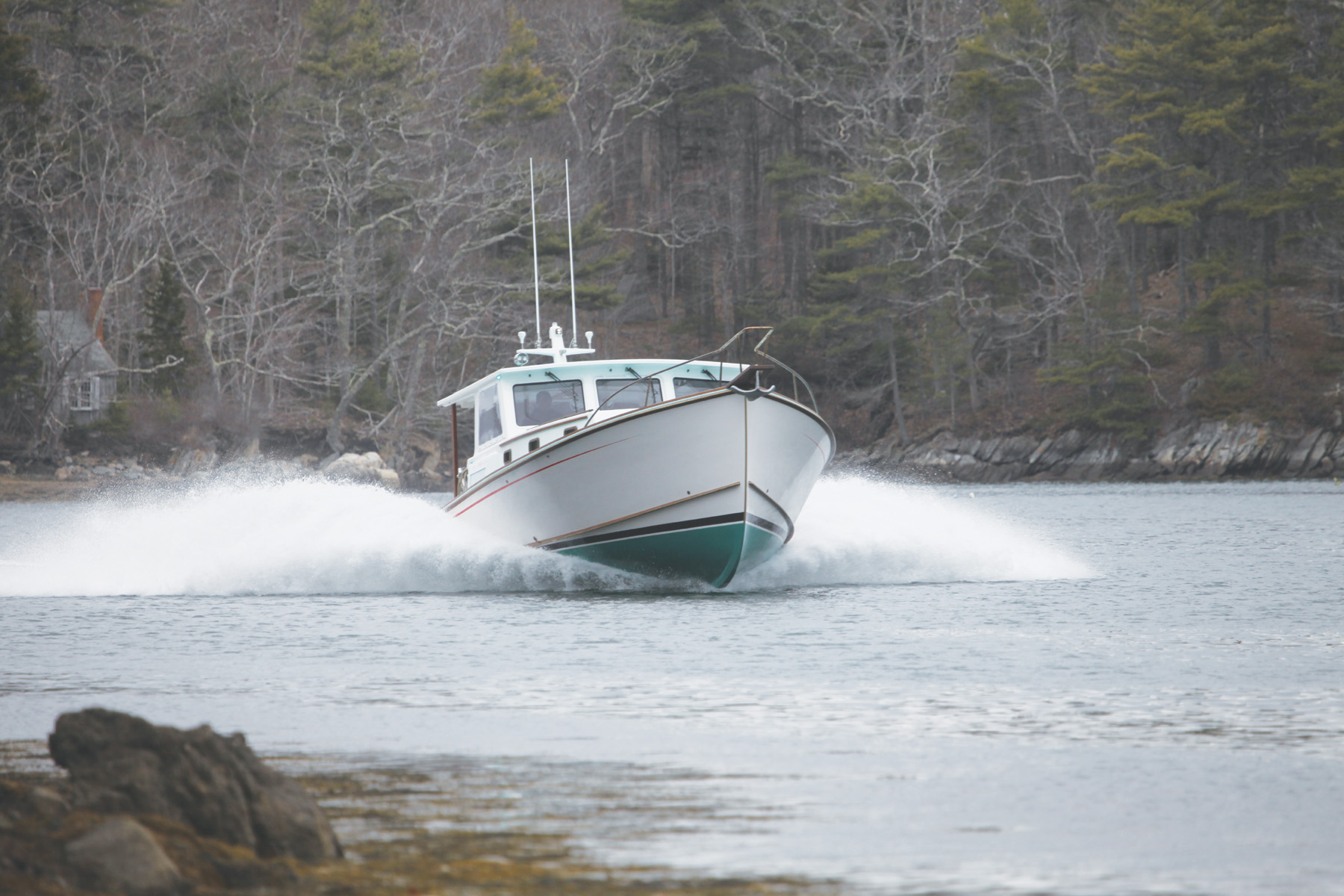
Farrin’s Boat Shop of Walpole doing sea trials on the new JANA B. of Kingstown, Saint Vincent and the Grenadines in South Bristol on 22 April. She is a Young Brothers 40 finished out as a sportfish boat powered with a 725-hp Volvo diesel.
TAUTOG MANAGEMENT BOARD
Meeting Summary
The Tautog Management Board met to review a Technical Committee (TC) report on the tasks assigned by the Board in response to the 2025 stock assessment update and provide guidance to the Plan Development Team (PDT) on Draft Addendum I.
In response to the 2025 stock assessment update, which found overfishing is occurring in the New Jersey-New York Bight (NJ-NYB) and Delaware, Maryland and Virginia (DMV) regions, the Board tasked the TC with (1) developing harvest projections to determine the reductions necessary to reach a 50% probability of achieving the fishing mortality (F) target by 2028 and 2030, (2) use the Risk and Uncertainty Tool in developing additional projections, and (3) provide a qualitative review of new fishery-independent surveys in the DMV region.
According to the projections, the NJ-NYB region would need a 44% reduction to have a 50% probability of achieving the F target in 2028, and a 40% reduction would be needed to have a 50% probability of achieving the F target in 2030. In the DMV region, maintaining status quo removals (i.e., removals equal to the 2022-2024 average) would result in a greater than 50% probability of being at or below the F target in both 2028 and 2030, meaning no reduction would be needed. This was likely due to the very strong year-classes in 2020-2023 that will be moving into the exploitable size classes over the next few years and the three-year average of removals was lower than the 2021-2023 removals, which were recent highs. Utilizing the Risk and Uncertainty Tool to determine the probability percentage to achieve the F target resulted in a recommended probability of 64% for the NJ-NYB region and 66% for the DMV region, and the projections were re-run to calculate the reduction needed under these new probabilities. However, the Board ultimately opted to develop the options in Draft Addendum I using a 50% probability of achieving the F target. Additionally, the TC reviewed Maryland DNR’s Submerged Aquatic Vegetation Habitat Survey and the Delaware Ventless Trap Survey and considered both surveys promising for providing additional data for consideration in the next benchmark assessment.
After reviewing the projections, the Board provided guidance to the PDT on how to draft options to achieve the necessary reductions in Draft Addendum I. First, the Board opted not to wait for re-calibrated Marine Recreational Information Program values that are expected in August 2026. As a result, the Draft Addendum will be considered for approval for public comment at the 2026 Summer Meeting with potential final action at the 2026 Annual Meeting. Furthermore, the Board requested the PDT develop options with a 50% probability of achieving the F target by 2030, including options to change the fishing seasons and bag limits. Finally, the Board added a section to the document for options to allow for states to implement a second tag in the commercial tagging program to provide more flexibility for harvesters in the live market to use a more preferred tag, if one can be found to be suitable.
For more information, please contact James Boyle, Fishery Management Plan Coordinator at jboyle@asmfc.org.
Motions
Move to continue forward with the addendum process and not delay for the re-calculated MRIP data.
Motion made by Dr. McNamee and seconded by Mr. Hasbrouck. Motion carries (7 in favor, 2 opposed).
AMERICAN LOBSTER MANAGEMENT BOARD
Meeting Summary
The American Lobster Board met to review a report from the Technical Committee (TC) on two Board tasks; approve nominations to a Steering Committee to develop a process to define management objectives for the Gulf of Maine/Georges Bank (GOM/GBK) fishery; receive updates from Maine, New Hampshire, and Massachusetts on recent industry meetings with the Gulf of Maine lobster industry; and receive a report from NOAA Fisheries on the Request for Information (RFI) on alternative gear marking; and review a list of outstanding management changes for future consideration. The Board also approved a nomination to the American Lobster Advisory Panel (AP).
After reviewing the 2025 Stock Assessment the Board tasked the TC with estimating the benefits to the GOM/GBK fishery that would have resulted from implementing the minimum gauge size increases under the repealed Addendum XXVII. The TC addressed this task by simulating the impacts of the Addendum XXVII gauge and escape vent size changes as if they had been triggered in 2018 and implemented from 2019-2023. This approach allowed the management actions to play out through a period of time when recruitment and fishing mortality estimates were reliably informed by estimates from the recent stock assessment. Relative to simulations where no changes to the gauge or vent sizes were implemented, the results of the TC analysis show decreases to the number of lobsters landed in the years where the two gauge sizes and the vent size changed, before stabilizing at slightly lower catch numbers. By weight, landings initially decreased in the years when the gauge size increased and then stabilized at a greater landings weight. Upon full implementation of the simulated management measures, landings stabilized at a ~4% decrease in the total number of lobsters landed, but an increase of 6% in landed weight because lobsters were landed at a larger size. The gauge changes resulted in a shift in the size composition of landings, with the primary shift being the replacement of many “chicks” (<1¼ lbs.) by “quarters” (1¼ – 1½ lbs.), and “halves” (1½ – 1¾ lbs.). The protection of smaller individuals through the increased gauge and vent size regulations also resulted in an increase in reference abundance and spawning stock biomass, and reduced exploitation rates. The Board acknowledged that as management measures are considered moving forward, there will also need to be an analysis of the economic and market impacts of those measures.
The TC also reported on a task from the Board to provide input on a proposal to modify the lobster fishery season closure in Lobster Conservation Management Area (LCMA) 5, which spans the southern part of New Jersey through Virginia. The proposal is to change the rules to allow traps to be set 15 days earlier (March 9 instead of 24) and to be re-hauled for harvesting black sea bass, require gear to be removed by January 15, and prohibit the retention of lobster from January 16 to March 15. The intent of the proposed change is to allow LCMA 5 lobster permit holders to target black sea bass earlier in the season by effectively shifting the closure earlier by two weeks. The TC noted that because the closure was implemented over a decade ago, recent landings data during the period of the proposed dates are not available to project changes in exploitation, but the TC believes the proposed change has the potential to marginally increase lobster exploitation because catchability in March is expected to be greater than in January. As an alternative approach to increase access to black sea bass, the TC suggested modifying the rules governing the setting and hauling of trap gear during the closure (e.g., allowing pots to be set and fished for black sea bass March 9 instead of March 24, as proposed) while maintaining the dates during which lobster harvest and possession is prohibited. This change would not be expected to increase lobster mortality. The states indicated they will convene a Lobster Conservation Management Team (LCMT) meeting for Area 5 to develop a conservational equivalency proposal for Board consideration. It was also noted that a federal rulemaking process would be required to change the closure rules in federal waters.
Maine and New Hampshire reported on recent meetings with stakeholders to identify potential management approaches for the Gulf of Maine. Maine is continuing to hold meetings with its Lobster Advisory Committee to discuss management measures and conservation efforts. New Hampshire recently presented the results of an industry survey on lobster management and fishermen’s perceptions.
The Board received an update from NOAA Fisheries on the status of the RFI to gather additional information on ropeless gear and visualization technology. NOAA Fisheries indicated that the RFI is currently under review. The RFI aims to better inform stakeholder input and Council decision- making regarding the development of the Joint New England and Mid-Atlantic Fishery Management Councils’ Alternative Gear Marking Framework Adjustment, which will consider changes to surface-marking requirements that would allow the use of fixed gear without a persistent buoy line as a possible approach for reducing entanglement risk for large whales.
The Board also reviewed a list of potential management changes that had been recommended in previous discussions of the Board and with the Lobster Conservation Management Teams (LCMTs). The list of possible management changes included allowing harvesters in LCMA 2 (Southern New England) to maintain a maximum of 2 permits with 800 traps each for a total of 1600 traps, allow the transfer of traps between permits owned by a single entity without the conservation tax, maintain active trap limits and ownership caps for LCMA 3 (federal waters), and shifting the seasonal closure in LCMA 5. The Board will maintain this list as a living document so these changes can be considered when future actions are taken.
The Board also appointed Chris Townsend, a Massachusetts lobster trap fisherman, to the American Lobster AP. For more information, please contact Caitlin Starks, Senior Fishery Management Plan Coordinator, at cstarks@asmfc.org.
Motions
Move to approve the nominations to the Steering Committee on Lobster MSE.
Motion made by Mr. Wilson and seconded by Dr. McNamee. Motion carries by unanimous consent.
Move to approve the approve the nomination of Chris Townsend from Massachusetts to the Lobster Advisory Panel to replace Eric Lorentzen.
Motion made by Mr. Glenn and seconded by Mr. Cimino. Motion carries by unanimous consent.
ATLANTIC STRIPED BASS MANAGEMENT BOARD
Meeting Summary
The Atlantic Striped Bass Management Board met to discuss guidance on biological reference points (BRPs) and spatial management for the 2027 benchmark stock assessment, as well as the composition, task details and timeline of the Board Work Group on future striped bass management; and receive updates on Maryland’s Addendum II implementation, and a timeline and process for feedback to NOAA on its Striped Bass Aquaculture Plan.
The Board provided guidance to the Atlantic Striped Bass Stock Assessment Committee (SAS) on the development of the upcoming assessment’s BRPs (i.e., targets and thresholds for spawning stock biomass and fishing mortality) that would address the Board’s current and future management objectives. The Board requested the SAS continue to explore both model-based reference points, such as MSY, SPR40% and SPR50%, as well as other options for empirical reference points including treating the 1995 spawning stock biomass (SSB) value as a target and using 75% of that value as a threshold. The Board requested the SAS investigate the relationship between SSB, recruitment, and environmental factors to further inform the thresholds and consider other metrics for stock health such as a wide age structure, total abundance, catch rates, and the spatial extent of the stock. The Board expressed continued interest in spatial reference points and recommended Delaware Bay be included in the Chesapeake Bay producer area region instead of being included in the ocean region.
The Board provided additional guidance for the Work Group (WG) on future striped bass management, established by the Board in October 2025. The WG is intended to discuss management beyond 2029 considering the impact of recent low recruitment as those weak year- classes become the majority of the spawning stock biomass in the coming years. Staff presented several options for WG formation and possible timelines to address the WG tasks. The Board agreed with the staff recommendation to wait until after the assessment completion to address assessment-related tasks (BRPs, recruitment drivers, spawning areas, size-based management). After discussion of several approaches for the WG, the Board will establish a steering committee which will provide guidance on work group tasks and timelines. The steering committee will be comprised of 6 Board members (Board Chair plus 1 from each spawning area/region: Chesapeake Bay, Delaware Bay, New York Hudson River, Southern New England, Northern New England). The Board also expressed its desire to hold a management objectives workshop in 2027.
In February 2026, the Board approved state implementation plans for Addendum III to Amendment 7 on the measurement of total length and the Maryland Chesapeake Bay recreational season. Maryland’s implementation plan notified the Board of the state’s decision to move forward with implementing the new recreational season baseline and was working through its state process for implementation at the time. On March 31, Maryland announced the state 2026 recreational striped bass regulations, which are consistent with its implementation plan.
NOAA Fisheries developed a report on the science and environmental issues as well as legal and policy issues regarding striped bass aquaculture. This report was presented to the Board at its February 2026 meeting. NOAA is seeking feedback on its report from the Commission. Based on Board feedback that will be provided to staff over the summer, a draft letter will be presented to the Board for its review at the Commission’s August meeting.
Lastly, Nichola Meserve from the Commonwealth of Massachusetts was elected Vice-Chair. For more information, please contact Toni Kerns, Fisheries Policy Director, at tkerns@asmfc.org.
Motions
Move to use a steering committee process.
Motion made by Ms. Madsen and seconded by Mr. Sikorski. Motion passes by unanimous consent.
Move to elect Nichola Meserve as the Vice-Chair of the Atlantic Striped Bass Management Board.
Motion made by Ms. Ware and seconded by Mr. Clark. Motion passes by unanimous consent.
ATLANTIC COASTAL COOPERATIVE STATISTICS PROGRAM COORDINATING COUNCIL
Meeting Summary
The Atlantic Coastal Cooperative Statistics Program (ACCSP) Coordinating Council met to take action on the FY2027 RFP (Request for Proposals), discuss NOAA recreational fishing initiatives, and receive ACCSP program updates.
The Council reviewed the recommended updates to the Funding Decision Process, general proposal guidelines, and review schedule as presented by the Operations Committee and Advisory Panel. The Council approved the FY2027 RFP with modified language on the proposal guidelines to note that “Proposals that request funding to purchase 3rd party data or develop/purchase 3rd party software that is similar (e.g., performing existing functions) to software offered by ACCSP will be considered on a case-by-case basis.”
ACCSP staff presented a summary of the process to request changes to the Access Point Angler Intercept Survey to include more detailed area fished and depredation information. NOAA staff presented updates on the Recreational Angler Partnership Improvement Directive (RAPID), Marine Recreational Information Program estimate publication dates, and the next National Saltwater Recreational Fishing Summit planned for March 2027.
The Council received an update of ACCSP program activities, including recreational initiatives,
2025 commercial landings publication, software development projects, major cross-team projects, and regional partner coordination.
For more information, please contact Geoff White, ACCSP Director, at Geoff.White@accsp.org.
Motions
Move to approve the ACCSP FY2027 RFP as presented, including updated language in the funding decision document as amended today.
Motion made by Ms. Zobel and seconded by Dr. McNamee. Motion approved by consent.
ATLANTIC MENHADEN MANAGEMENT BOARD
Meeting Summary
The Atlantic Menhaden Management Board met to (1) consider approval of Draft Addendum II on the Chesapeake Bay reduction fishery for public comment; (2) review a Technical Committee (TC) report on the Board task regarding changing environmental conditions; (3) review a report from the Committee on Economics and Social Sciences (CESS) regarding the economic impacts of changing the total allowable catch (TAC); (4) receive an update on a Request for Proposals being developed for Chesapeake Bay research; (5) elect a Vice Chair; and (6) approve a nomination to the Advisory Panel.
In October 2025, the Board initiated Draft Addendum II to Amendment 3 to develop options to more evenly distribute harvest of the Chesapeake Bay Reduction Fishery Cap (Bay Cap) into quota periods as well as consider reductions in the Bay Cap up to 50%. The Plan Development Team (PDT) incorporated the Board’s feedback from February into the Draft Addendum and drafted a memo of additional information requested by the Board as well as options that the PDT considered and rejected. Specifically, the Board’s tasking included: comparing reduction effort with harvest data within quota periods; investigating pound net and reduction catch rates to determine if pound net landings are correlated with the timing of the reduction fishery; and summarizing pound net participation over time.
The Board discussed the complexity of the Draft Addendum II options, particularly regarding the interaction between accounting for overage penalties between years and allowing underharvested quota to rollover between periods within the same year. In addition to providing edits to the problem statement and requesting text to clarify certain provisions, the Board opted to establish a Work Group of Board members to work with the PDT in further developing the document. The Work Group and PDT will consider tasking the TC with investigating pound net and reduction fishery catch rates, since the PDT recommended that the TC would be a more appropriate body to provide further analysis, if possible. The Board will review and consider approving the revised Draft Addendum for public comment at the 2026 Summer Meeting.
At the 2025 Annual Meeting, the Board tasked the TC with reviewing information from NOAA’s Ecosystem Dynamics and Assessment Branch and Chesapeake Bay Office, and the Woods Hole Oceanographic Institution to evaluate the possible effect of cold water on the Continental Shelf on Atlantic menhaden migration and migratory patterns, particularly in relation to the timing of osprey arrival, nesting, and breeding. The Board also tasked the TC with considering what role water temperature, dissolved oxygen levels, shoreline hardening, and other environmental
factors play in the local abundance of menhaden and other forage species in the Chesapeake Bay. The TC conducted a literature review on the key topics identified by the Board that could serve as a basis for a more quantitative approach if tasked by the Board. The TC noted that many factors within a species’ physical environment will influence abundance, distribution, and timing of population events such as spawning and migration. Additionally, the TC stressed that the existing datasets may not be sufficient to fully address the Board’s questions, given the limited spatial and temporal coverage of both fishery- dependent and -independent data. The Board did not provide any further tasking on this issue.
In October 2025, the Board also tasked the CESS with looking into how changes in Atlantic menhaden management could impact jobs within the fishery. There were two studies identified that address employment impacts associated with landings changes in the Atlantic menhaden fishery: Kirkley et al. 2011 and Whitehead and Harrison 2017. Kirkley et al. assessed the economic importance of the reduction sector under alternative harvest scenarios in Chesapeake Bay, including an approach that allowed for increasing costs associated with shifting harvest to coastal waters in response to reductions in the Chesapeake Bay quota. The study estimated the reduction sector supported approximately 519 full- and part-time jobs in Maryland and Virginia, including 347 in Northumberland County, Virginia, associated with total landings of about 141,000 metric tons (mt), of which roughly 85,000 mt were harvested from Chesapeake Bay. Under an extreme scenario in which no harvest was allowed in the Bay and effort could not be shifted to coastal waters, employment losses in Northumberland County were estimated at up to 176 jobs, including 98 direct losses in the reduction sector. The analysis also indicated that a reduction of 1,000 mt in the Chesapeake Bay quota corresponded to an estimated loss of approximately 3.7 total jobs, including 2.1 direct jobs in the reduction sector.
Whitehead and Harrison applied a similar modeling framework and produced employment impact estimates consistent with Kirkley et al. In addition, this study estimated that employment changes in Northumberland County scale with output at approximately one job per $45,000 in landings (roughly $60,000 in 2026). CESS noted that estimates should be interpreted cautiously in a management context. Because the type of model used (i.e., the Leontief input–output model) does not account for market adjustments or adaptive behavior, they likely overstate long-term employment effects. However, both studies note the reduction industry is a critical sector in the local economy, and that it may be challenging for employees to transition to other sectors if there are job losses. CESS recommends additional socioeconomic research to support menhaden management decisions.
The Board received an update on funding included in federal appropriations for Chesapeake Bay menhaden research. The Commission is developing a Request for Proposals to evaluate research projects for funding based on the priority studies identified in the October 2023 report from the Virginia Institute of Marine Science.
Finally, the Board elected Nicole Lengyel Costa of Rhode Island as the Vice Chair and approved the nomination of Eric Lorentzen, a Massachusetts seine net fisherman, to the Atlantic Menhaden Advisory Panel.
For more information, please contact James Boyle, Fishery Management Plan Coordinator at jboyle@asmfc.org.
Motions
Move to add a no rollover provision to section 3.2.2.3.
Motion made by Mr. Luisi and seconded by Mr. LaFrance. Motion passes (10 in favor, 5 opposed, 1 null, 2 abstentions).
Move to reconsider the previous motion.
Motion made by Mr. Grout and seconded by Mr. Woodward. Motion passes (13 in favor, 3 opposed, 2 abstentions)
Move to add a no rollover provision to section 3.2.2.3.
Motion fails (3 in favor, 13 opposed, 2 abstentions).
Move to form a Work Group of the Atlantic Menhaden Board to work with the Plan Development Team on revisions to Draft Addendum II.
Motion made by Ms. Lengyel-Costa and seconded by Mr. Clark. Motion passes (16 in favor, 2 abstentions).
Move to elect Nicole Lengyel-Costa as Vice-Chair of the Atlantic Menhaden Board.
Motion made by Mr. Haymans and seconded by Mr. Reid. Motion passes by unanimous consent
Move to approve the nomination of Eric Lorentzen from MA to the Atlantic Menhaden Advisory Panel.
Motion made by Ms. Meserve and seconded by Mr. Gates. Motion passes by unanimous consent.
JOINT SESSION OF THE ATLANTIC AND GULF STATES MARINE FISHERIES COMMISSIONS’ LAW ENFORCEMENT COMMITTEES
Meeting Summary
The Law Enforcement Committee (LEC) conducted a joint meeting with the Gulf State Marine Fisheries Commission (GSMFC) LEC to review species issues; Joint Enforcement Agreements; Guidelines for Resource Managers on the Enforcement of Fishery Management Measures; the NOAA Field Forensic Program; Court Authorized Surveillance; enforcement case studies; and Illegal Unreported and Unregulated (IUU) fishing enforcement. A closed session was convened to discuss new and emerging issues in law enforcement.
Tautog Management Discussion – The Committee reviewed a proposal from the State of New York, which requests that Draft Addendum I include an option to allow states to use an alternate tag type for commercially taken tautog due to concerns regarding damage to fish retained in New York’s live market fishery. The LEC will work with staff to monitor this issue closely and stay informed about the research and testing conducted by the New York State Department of Environmental Conservation as it works to identify a suitable alternate tag option. The LEC supports the commercial tagging program outlined in the FMP and is open to endorsing an alternative tag, provided it meets the established requirements of the program.
Joint Enforcement Agreements (JEA) – ASAC Bryan Landry from NOAA Office of Law Enforcement
(NOAA OLE) engaged the Committee in a discussion concerning the status of the JEA program.
Funding for the JEA has been included in the FY2026 budget. The LEC as it supports the continuation and effectiveness of the JEA program.
The LEC reviewed its shared expectations and priorities regarding the JEA program. The Committee reaffirmed the commitment of participating states to the program’s objectives and collaborative enforcement efforts. Members expressed hope that NOAA OLE will further enhance funding for the JEAs in the FY2027 budget, strengthening the partnership and advancing fisheries enforcement initiatives.
Guidelines for Resource Managers – At the request of the GSMFC LEC, ASMFC staff delivered a comprehensive presentation of the Guidelines for Resource Managers on the Enforcement of Fishery Management Measures. Key points included the document’s evolution, its practical use in fisheries enforcement, and how it addresses challenges faced by managers working to ensure compliance with regulatory frameworks.
Field Forensic Program – NOAA has initiated pilot testing of a newly developed rapid polymerase chain reaction (PCR) device as a part of its Field Forensic Program. This technology allows officers to perform genetic analysis directly in the field, delivering immediate results and eliminating the need to send samples to external laboratories. US law prohibits the false labeling of imported seafood products. Despite this, visually identifying fish species during port inspections is often difficult, as physical characteristics alone may not be sufficient. In the past, NOAA officers collected genetic samples and sent them to forensic laboratories for confirmation, a process that could take weeks and potentially delay the movement of seafood through US ports.
The introduction of rapid PCR technology provides enforcement personnel with the capability to swiftly identify fish species on-site. This advancement helps officers collect evidence and investigate seafood fraud more efficiently. By expediting the identification process, the device helps prevent illegal seafood products from entering the US marketplace and strengthens the effectiveness of port inspection operations.
Court Authorized Surveillance Techniques – Sgt. Jeffrey Turcotte of the Maine Department of Marine Resources conducted a presentation on best practices in the use of court authorized surveillance techniques. Sgt. Turcotte highlighted successful case prosecutions from the state of Maine and the processes used in supporting these cases. This presentation focused on the illegal deployment of traps in the lobster fishery.
Case Study – Operation Scaled Deception – Lt. Patrick Carron from the Mississippi Department of Marine Resources (MSDMR) offered a presentation on this enforcement action as it relates to the fraudulent use of trip tickets in their commercial fisheries. The presentation detailed a multi-year investigation into illegal finfish harvesting and trafficking between Mississippi and Alabama, focusing on spotted seatrout and red drum. The investigation began in 2018 when Alabama Marine Resources Division (ALMRD) noticed large quantities of spotted seatrout being sold in Alabama without proper reporting on Mississippi trip tickets. Mississippi has strict regulations, including a total allowable catch for spotted seatrout, which was exploited by commercial fishermen who sold unreported catches to a seafood dealer in Alabama.
In 2020, complaints arose about suspiciously high quantities of red drum being harvested and sold, leading to further investigations. Authorities discovered fraudulent reporting, hidden compartments in boats, and connections between Mississippi and Alabama fishermen. Cellular data and social media posts revealed that fishermen were laundering illegally harvested fish from Alabama on Mississippi trip tickets.
The investigation, dubbed “Operation Scaled Deception,” involved collaboration between MSDMR, ALMRD, and the US Fish and Wildlife Service. It identified 44 participants in the scheme, resulting in 8 convictions, $21,446 in fines, and the lifetime forfeiture of gill net licenses for one dealer. The total amount of illegally harvested finfish was 101,673 pounds, with a retail value of $1.53 million. Key lessons learned include the need for better communication between agencies, the exploitation of regulatory differences between states, and the inadequacy of current fines to deter criminal activity.
Case Study: Operation Atlantis – Captain Scott Pearce from the Florida Fish and Wildlife Commission (FWC) offered a presentation on the false tagging of seafood products. This presentation discussed illegal lobster importation, mislabeling practices, enforcement actions, violations, and legal proceedings related to Florida fisheries. The FWC and NOAA investigated Florida-based seafood companies for allegedly importing massive quantities of Caribbean lobster, mislabeling them as US origin, and re-exporting to China. Inspections revealed violations such as improper reporting, lack of notification, and breaches of spiny lobster regulations. Federal charges including wire fraud and conspiracy were brought against two seafood dealers, highlighting concerns about reputational harm to American fishermen and insufficient government oversight.
IUU – Assistant Commander Game Warden Les Casterline of Texas Parks and Wildlife Division (TPWD) offered a presentation on his agency’s effort in enforcement of IUU fishing. He discussed illegal fishing activities along the Texas/Mexico border, enforcement efforts, new initiatives to combat seafood fraud, and regulations for seafood import monitoring. The Seafood Import Monitoring Program (SIMP) is designed to regulate the entry of seafood into the US. This program tracks the journey of seafood products from the point of harvest all the way through to their arrival at US borders. By monitoring this entire process, SIMP helps ensure that imported seafood meets legal requirements and maintains transparency throughout the supply chain. SIMP specifically targets thirteen priority species, all selected due to their vulnerability to illegal fishing practices and the need for greater oversight in their trade.
To support lawful harvesting and production, the program requires comprehensive recordkeeping and data collection for each imported shipment. Importers must provide detailed documentation that demonstrates the seafood was harvested and produced in accordance with established laws and regulations. This information is then used to verify compliance and prevent illegal, unreported, and unregulated fishing from impacting US markets. These enforcement efforts have been in collaboration with partnered agencies, including TPWD, NOAA, Customs OFO, USFW, and the FDA.
For more information, please contact Kurt Blanchard, LEC Coordinator, at kurt.blanchard@verizon.net.
HORSESHOE CRAB MANAGEMENT BOARD
Meeting Summary
The Horseshoe Crab Management Board met to consider the final report on the recent stakeholder engagement process to inform possible changes to the Adaptive Resource Management (ARM) Framework and review a summary of state legislation on horseshoe crab fisheries in Connecticut, New York, and New Jersey.
The Board received a report on the process initiated in 2026 to review and revise the Utility, Reward, and Harvest Policy (U/R/H) functions of the ARM Framework with input from stakeholders representing bait fisheries, biomedical groups, dealers, ecosystem, shorebird, and horseshoe crab conservation groups. Compass Resource Management was contracted as a third- party facilitator to design and conduct the stakeholder engagement process. The purpose was to elicit stakeholder values and perspectives to develop clear, actionable recommendations for revising the U/R/H functions, which are mathematical functions within the ARM model that reflect stakeholder priorities and values related to horseshoe crab harvest, shorebird populations, and the ecosystem. Through a series of educational meetings, an in-person workshop in January 2026, and input from the Delaware Bay Ecosystem Technical Committee (DBETC), stakeholders developed recommendations to update the economic value ratio of male to female horseshoe crabs in the bait fishery, better represent stakeholder perspectives on red knot population goals, and add a precautionary threshold for zero female harvest if the female horseshoe crab population in Delaware Bay falls below 7 million crabs. As a next step, the Board tasked the ARM Subcommittee with making the recommended changes to the ARM Model and testing the updated functions against the existing model. The DBETC will also review the updates and report back to the Board at the next meeting.
Staff provided a summary of state legislation related to horseshoe crab bait and biomedical fisheries in Connecticut, New York, and New Jersey. New Jersey implemented a moratorium on horseshoe crab bait harvest in 2008 but allows horseshoe crabs to be used for biomedical purposes. As of October 1, 2023, hand harvest of horseshoe crabs is prohibited in Connecticut, and New York passed legislation to phase out the commercial and biomedical harvest of horseshoe crabs by 2029. Some states expressed concern that restricting horseshoe crab harvest in these states could increase the demand for harvest from other regions.
For more information, please contact Caitlin Starks, Senior Fishery Management Plan Coordinator, at cstarks@asmfc.org.
Motions
No motions made.
COASTAL SHARKS MANAGEMENT BOARD
Meeting Summary
The Coastal Sharks Management Board met to consider updates on actions for the Highly Migratory Species (HMS) Fishery Management Plan (FMP) relevant to coastal sharks; a presentation on changes to the Convention on the International Trade of Endangered Species (CITES) and impacts on smoothhound sharks; and the FMP Review of the 2024 Fishing Year and state compliance.
The Board received updates from NOAA Fisheries on federal rulemaking for the HMS FMP. A proposed rule was published January 6, 2026, that considers revising commercial Atlantic blacknose shark and recreational Atlantic shark fisheries management measures. This rulemaking responds to the framework for implementing management measures established in Amendment 14 and aims to increase management flexibility and optimize quota utilization of Atlantic shark commercial and recreational fisheries. The proposed rule seeks public input on alternatives related to blacknose shark management boundaries and commercial retention limits, Atlantic shark recreational size limits and retention limits, and management group quota linkages. The comment period on this action was extended to May 29, 2026, and a final rule is expected in late 2026.
The Board received a presentation from the US Fish and Wildlife Service (FWS) on the recent inclusion of tope sharks and all smoothhound sharks of the genus Mustelus to CITES Appendix II. This listing will impact permit requirements for smooth dogfish exports. Beginning June 5, 2027, exports and re-exports from the US of smoothhound sharks, whether alive or dead, and any parts or derivatives must be accompanied by a CITES export permit or re-export certificate issued by the FWS Division of Management Authority. Imports of smoothhounds into the US must be accompanied by a CITES document issued by the country of export or re-export. Stakeholders are advised to apply for the necessary permits three to six months in advance to avoid export delays.
The Board approved the Coastal Sharks FMP Review for the 2024 fishing year, state compliance reports, and de minimis status for Massachusetts. Ben Dyar of South Carolina was elected Vice- Chair of the Coastal Sharks Board.
Lastly, the Board discussed a possible agenda item for a future meeting that would include a presentation on a study of land-based recreational shark fisheries in North Carolina, as well as state regulations related to shore-based shark fisheries. For more information, please contact Caitlin Starks, Senior Fishery Management Plan Coordinator, at cstarks@asmfc.org.
Motions
Move to approve the Fishery Management Plan Review and state compliance for coastal sharks for the 2024 fishing year, and approve de minimis status for Massachusetts.
Motion made by McKiernan and seconded by Mr. Haymans. Motion approved by consent.
Move to elect Ben Dyar as Vice-Chair of the Coastal Sharks Board.
Motion made by Mr. Batsavage and seconded by Dr. Rhodes. Motion approved by consent.
ANNUAL AWARDS OF EXCELLENCE
ASMFC Honors 2026 Annual Award of Excellence Recipients
The Atlantic States Marine Fisheries Commission (ASMFC) is proud to announce the recipients of its 2026 Annual Awards of Excellence, recognizing outstanding contributions to the management, policy development, enforcement, and public understanding of Atlantic coastal fisheries. This year’s honorees represent excellence across four key areas: fisheries management and policy, legislative leadership, outreach, and law enforcement.
“These award recipients exemplify the dedication, expertise, and collaborative spirit necessary to sustain our nation’s marine resources,” said ASMFC Chair Daniel McKiernan of Massachusetts. “Their work strengthens not only their respective fields, but also the entire interstate fisheries management process.”
Management & Policy Award
John Clark — Delaware Division of Fish and Wildlife (Retired)
John Clark is honored for a distinguished career in fisheries management and policy, marked by more than a decade of service as Delaware’s Administrative Commissioner to ASMFC. Since 2011, he has played a central role in guiding the Commission’s work on complex and often contentious fisheries issues.
Mr. Clark has chaired several key management boards, including those overseeing horseshoe crab, Atlantic menhaden, and American eel fisheries. He is widely respected for his fairness, efficiency, and ability to navigate technical and policy challenges while fostering productive dialogue among diverse stakeholders.
His contributions to the development and application of innovative management tools, such as the horseshoe crab Adaptive Resource Management Framework model, have supported the recovery of important species and provided benefits across ecological, commercial, and biomedical sectors.
Prior to his administrative role, Mr. Clark built a strong foundation as a field researcher and scientist, contributing significantly to the understanding of fisheries and invertebrate ecology in Delaware waters.
His career reflects a rare combination of scientific expertise, policy leadership, and dedication to public service.
Congressional & Legislative Contributions Award
Alex Swanson — Legislative Assistant, Office of U.S. Senator Chris Van Hollen
Alex Swanson is honored for her exceptional contributions to advancing fisheries policy and securing critical federal support for ASMFC priorities. As a Legislative Assistant, she has demonstrated a deep understanding of coastal and marine issues, as well as the complex intersection of science, policy, and funding.
In fiscal year 2026, under a highly constrained budget environment, Ms. Swanson played a leading role in securing funding for key initiatives, including the Chesapeake Bay menhaden study and an industry-based trawl survey pilot program. These efforts will help address longstanding scientific questions, improve data collection, and support more effective fisheries management decisions.
Ms. Swanson’s experience working in both New England and Mid-Atlantic congressional offices has provided her with a broad perspective on interstate fisheries challenges. Her ability to translate technical needs into actionable legislative outcomes has made her an invaluable partner to ASMFC and its stakeholders.
Her leadership ensures that the needs of coastal communities, fisheries managers, and the scientific community are effectively represented at the federal level.
Outreach & Advisory Award
Francis “Fran” McParland — New York State Department of Environmental Conservation
Francis “Fran” McParland is recognized for his innovative and impactful approach to fisheries outreach and public engagement. His work has significantly enhanced public understanding of marine resource management across New York’s diverse marine environments, from Long Island Sound to the Atlantic Ocean and the Hudson River.
Through the development of creative, science-based communication strategies—including social media outreach and in-person engagement—Mr. McParland has successfully translated complex regulatory and scientific concepts into accessible and engaging messaging. His efforts have strengthened public trust in fisheries management and increased awareness of conservation priorities.
Mr. McParland regularly engages a wide range of stakeholders, including recreational and commercial fishing communities, educators, and youth groups. He has also organized and participated in hands-on events such as beach cleanups and environmental awareness initiatives, fostering a culture of stewardship and community involvement.
In addition to his outreach work, he has demonstrated leadership within the professional community, including serving as President of the New York Chapter of the American Fisheries Society. His contributions have had a lasting impact on both public engagement and professional collaboration in fisheries management.
Law Enforcement Award
Corporal Vincent “Vinny” Artrip — Maryland Natural Resources Police
Corporal Vincent “Vinny” Artrip is recognized for his exceptional leadership and effectiveness in fisheries law enforcement along Maryland’s Atlantic coast. Assigned to one of the region’s most active coastal districts, Corporal Artrip has demonstrated extensive expertise in both recreational and commercial fisheries enforcement, handling complex cases involving species managed under overlapping state and federal regulations.
Over the past year, his enforcement efforts have addressed violations involving key Atlantic species such as striped bass, black sea bass, flounder, tautog, as well as federally managed pelagic species including bluefin tuna and billfish. His work requires a high level of technical knowledge and the ability to navigate evolving regulatory frameworks.
A deputized officer under the Joint Enforcement Agreement program, Corporal Artrip works closely with NOAA Fisheries and federal enforcement partners to ensure alignment with national fisheries management objectives. He also maintains strong working relationships with neighboring state agencies, supporting coordinated enforcement efforts across jurisdictional boundaries.
In addition to his operational work, Corporal Artrip has contributed to regulatory development discussions, assisted with the transition to federal reporting systems for highly migratory species, and delivered training to fellow officers and partner agencies. His efforts have enhanced both compliance and interagency coordination, making a lasting impact on fisheries enforcement in the region.
EXECUTIVE COMMITTEE
Meeting Summary
The Executive Committee met to discuss several issues including a review of the Commission’s FY27 Budget and the President’s FY27 budget request, and receive updates on legislation, CARES cooperative agreement, and future annual meeting locations.
Staff presented the draft Commission’s FY27 Budget, which was unanimously approved by the Executive Committee.
The Committee reviewed the President’s FY27 budget request. Funding has been reduced for a number of ASMFC budget priorities. Staff and the states will work to restore federal funding for these important Atlantic coastal fisheries science and management priorities.
Staff provided an update on recent legislative activity, including a summary of the State Boating Act and reauthorization of the Sport Fish Restoration Act.
Staff provided an update on the CARES cooperative agreement. The Commission continues to try to collect funds from those who received funds deemed ineligible. The current deadline for the Commission to pay remaining funds is December 4, 2026.
Lastly, staff provided an update on future Annual Meeting locations. In 2026, Rhode Island will host the annual meeting, November 8-12 at the Viking Hotel in Newport. In the following years the host states are: 2027 South Carolina; 2028 Massachusetts; 2029 Pennsylvania, 2030 Georgia and 2031 Connecticut.
For more information, please contact Laura Leach, Director of Finance & Administration, at lleach@asmfc.org or 703.842.0740.
Motions
Move to approve the FY2027 Budget.
Motion made by Mr Cimino and seconded by Mr. Grist. Motion carries without objection.
SCIAENIDS MANAGEMENT BOARD
Meeting Summary
The Sciaenids Management Board met to consider Georgia’s and South Carolina’s red drum management measures proposals to implement Addendum II; consider North Carolina’s conservation equivalency proposal for its spot commercial fishery; consider a report from the Sciaenids Board Plan Review Teams (PRTs) regarding a Board task to review Board species’ de minimis provisions; as well as receive updates on the 2026 Atlantic Croaker Benchmark Stock Assessment and the Southeast Area Monitoring and Assessment Program (SEAMAP).
In October 2025, the Board approved Addendum II to Amendment 2 to the Interstate Fishery Management Plan (FMP) for Red Drum, which updated red drum management in response to the 2024 stock assessment results. The Addendum modified the fishing mortality (30% spawning potential ratio or F30%) the southern stock will aim to meet with implemented management measures. Florida implemented more restrictive red drum regulations in September 2022 immediately following the assessment model time series; these measures are estimated to have achieved the minimum 14.4% reduction in catch associated with F30%. South Carolina and Georgia each submitted a proposal with a range of regulatory options which achieve reductions greater than the 14.4% reduction. Based on the least and most restrictive regulatory options in both proposals, the southern stock is estimated to achieve a reduction ranging between 19.6% and 24.2%. The Board approved all management options in both proposals. The implementation date for all new measures is September 1, 2026, which Georgia and South Carolina have both confirmed they are on track to achieve.
The Board approved a conservation equivalency proposal submitted by North Carolina for its spot commercial fishery. North Carolina requested an adjustment of its spot commercial fishing season closure period from December 10th through April 4th to January 1st through April 28th. A later closure period would address comments North Carolina has received from commercial fishermen in the southern portion of the state, who have observed peak harvest of large, adult spot later in the year, coinciding when the current closure period is starting. North Carolina’s current spot commercial fishery closure was first implemented in 2021 following the 2020 triggering of the spot traffic light analysis, which required states to implement measures which are estimated to achieve a 1% reduction in the previous 10-year average of spot commercial harvest. The proposal estimates a closure from January 1st through April 28th would achieve a reduction in harvest (6,940 lbs.) that would exceed both the plan required 1% reduction (5,126 lbs.) and the estimated reduction achieved by the current closure period (5,281 lbs.). Following the process established in the Commission’s Conservation Equivalency Guiding Document, the Spot PRT, Technical Committee, Law Enforcement Committee, and South Atlantic Advisory Panel all reviewed the proposal and did not have any concerns.
The Board considered a report from the Atlantic Croaker, Black Drum, Red Drum, Spot, and Spotted Seatrout PRTs regarding a Board task to provide recommendations on: (1) whether the current 1% threshold for a state to be considered de minimis is appropriate and (2) whether there may be alternate ways to evaluate whether a state is de minimis. De minimis provisions in interstate FMPs are meant to reduce the regulatory burden for states whose measures would have a negligible effect on the conservation of a species. In the past 5-10 years, several states have had reoccurring issues with how de minimis is currently defined for species such as spot and Atlantic croaker. The PRTs’ report offers several possible solutions, which either modify the current definition of de minimis or modify the de minimis process. The Board did not move forward with any specific action at this time but indicated an interest in exploring possible management action following the release of the results of the Atlantic Croaker Benchmark Stock Assessment and Peer Review Report at the ASMFC Annual Meeting 2026 in November. This way, if the assessment leads the Board to consider possible management action, any changes to de minimis provisions could also be addressed in the same management document.
The Board received an update on the 2026 Atlantic Croaker Benchmark Stock Assessment. The Stock Assessment Subcommittee held an in-person assessment workshop from March 2-6, 2026. A peer review workshop is tentatively scheduled for July 2026. The assessment and peer review report is scheduled to be presented to the Board at Annual Meeting. The spot benchmark assessment will begin once the Atlantic croaker assessment completes peer review in July 2026, with the goal to be peer-reviewed in June 2027 and presented to the Board at Annual Meeting 2027. Given this timeline, the Board agreed an updated traffic light analysis for spot would not need to be completed in 2026.
The Board received an update on SEAMAP, which is a cooperative program for the collection, management, and dissemination of fishery-independent data and information in the southeastern US used to inform fishery management decisions for fisheries in coastal areas. There are three components to the program: the Gulf, the South Atlantic, and the Caribbean. Currently, assessments for several Commission species use SEAMAP data including red drum (2024), Atlantic menhaden (2025), and bluefish (2025). To support the long-term planning for this program and to improve efficiency and effectiveness of the surveys, the SEAMAP committees have put together a strategic plan for their next funding cycle. The aim of this document is to summarize the importance of each survey and outline proposed enhancements for improvements.
Under other business, several states, including Virginia, North Carolina, and Florida, provided an update on cold stun events which occurred in their waters earlier this year. Their impact on the population of species such as spotted seatrout and red drum is currently unknown but will continue to be monitored by the states.
For more information, please contact Tracey Bauer, Fishery Management Plan Coordinator, at tbauer@asmfc.org.
Motions
Move to approve South Carolina and Georgia’s range of options in their respective red drum management proposals to implement Addendum II.
Motion made by Mr. Woodward and seconded by Dr. Rhodes. Motion passes by unanimous consent.
Move to approve North Carolina’s conservation equivalency proposal for its spot commercial season.
Motion made by Mr. Batsavage and seconded by Mr. Simpson. Motion passes by unanimous consent.
AMERICAN EEL MANAGEMENT BOARD
Meeting Summary
The American Eel Management Board met to consider a report from the Technical Committee (TC) and Stock Assessment Subcommittee (SAS) on their evaluation of Florida’s proposal to discontinue the annual young-of-year (YOY) survey, review preliminary yellow eel landings for 2025, and elect a Vice-Chair.
The Board received a report from the TC and SAS regarding the evaluation of Florida’s YOY survey. Florida submitted the proposal in October 2025 and the Board tasked the TC with evaluating the utility of continuing the Florida YOY survey and its contribution to the Commission’s management and assessment of the American eel stock. The TC and SAS reviewed the YOY survey data and an alternative electrofishing survey in Florida. They reported that the FL YOY survey has an unusual methodology, has had irregular management of the lake where it occurs, gives limited signals for population trends, and is not used for management. While they concluded that on its own the Florida survey does not contribute significantly to the assessment of the stock, collectively, state eel recruitment surveys could serve as a warning signal of stock-wide recruitment failure. The Board approved an alternative state management program to exempt Florida from conducting the YOY survey with the requirement to continue of the electrofishing survey. The SAS recommended evaluating the Florida electrofishing survey and discussing the use of YOY surveys during the next benchmark stock assessment process.
The Board reviewed preliminary yellow eel landings for the 2025 fishing year to evaluate them against the coastwide landings cap. Preliminary coastwide landings in 2025 were 260,348 pounds, excluding confidential data. This is a 19% decrease from 2024 and well below the coastwide cap. Maine provided updates on the 2026 glass eel fishery and the state’s aquaculture allocation. The 2026 glass eel fishery is ongoing, but prices and landings are significantly lower than they have been in recent years. It is suspected reduced fishing effort in Maine is due to lower market prices resulting from decreased demand in the international market and greater supply from other sources, such as, an increase in Canada’s glass eel quota. Additionally, Maine reported the eel aquaculture company American Unagi is no longer in business; therefore, Maine will not use its 200-pound aquaculture allowance this year and will not apply for the allowance for 2027.
Heather Corbett of New Jersey was elected Vice-Chair of the Eel Board. For more information, please contact Caitlin Starks, Senior Fishery Management Plan Coordinator, at cstarks@asmfc.org.
Motions
Main Motion
Move to approve an alternative management program to exempt Florida from the American Eel FMP requirement in section 3.1.1 to conduct an annual young-of-year abundance survey. Motion made by Ms. Burgess and seconded by Dr. Rhodes.
Motion to Amend: Move to amend to add “and require the continuance of the electrofishing survey.”
Motion made by Mr. Clark and seconded by Ms. Kennedy. Motion passes (11 in favor, 5 opposed, 1 abstention).
Main Motion as Amended
Move to approve an alternative management program to exempt Florida from the American Eel FMP requirement in section 3.1.1 to conduct an annual young-of-year abundance survey and require the continuance of the electrofishing survey.
Motion passes by unanimous consent.
Move to elect Heather Corbett as Vice-Chair of the American Eel Management Board.
Motion made by Ms. Zobel and seconded by Mr. Edwards. Motion passes by unanimous consent.
INTERSTATE FISHERY MANAGEMENT PROGRAM (ISFMP) POLICY BOARD
Meeting Summary
The ISFMP Policy Board met to receive reports from the Executive Committee (see earlier Executive Committee summary), Habitat Committee, Law Enforcement Committee (see earlier LEC meeting summary), and Assessment Science Committee; review a report from the Declared Interest and Voting Privileges Work Group (WG); receive an update on the Recreational Angler Partnership Improvement Directive (RAPID) initiative; and discuss proposed changes to the Monterey Bay Aquarium Seafood Watch’s standards for fisheries.
Since last spring, the Commission’s Executive Committee has discussed issues related to states declared interests and voting privileges on species management boards prompted by several circumstances. Most notable is the changing distribution of many species managed by the Commission, which in turn has resulted in (and is anticipated to result in additional) interest by states to alter their participation on species management boards. The Executive Committee formed a Work Group (WG) to develop possible solutions to concerns that the criteria listed in the Commission’s Rules and Regulations for states to declare into a fishery are not specific enough to help guide the Policy Board in evaluating a declared interest request. The WG recommended changes to the criteria, which are meant to add specificity to the eligibility criteria, clarify valid data sources, correct for redundant and outdated language, and better reflect the species and fisheries under Commission management. The Board will consider taking action on modifications to the Rules and Regulations at the Commission’s Business Session in August.
As part of this discussion, the Board also considered a set of Voluntary Voting Guidelines that provided a set of circumstances with an indication of when a state should consider voting verses abstaining. Voting privileges can be complex issue. The ISFMP Charter establishes that all states with a declared interest in a fishery are voting members of the board, eligible to participate in all board votes. The impetus, in part, for considering guidelines to voting practices is a range of philosophies regarding the role of Commissioners. While all recognize that Commissioners are selected by their states to represent their interests and consider the sustainability of the stocks managed under the Commission, there are differing views of the role of Commissioners on their responsibilities that extend beyond their state’s jurisdiction. During the discussion considering the guidelines, some Commissioners expressed that their role is to participate in the management across the entire Atlantic coast serving as a trustee for all populations of fish managed by the Commission, while other Commissioners expressed their role is to advocate and support their state fisheries, in concert with other states, but not as a coastwide manager. The Board did not approve the guidelines at this time.
The Habitat Committee Chair presented information on the Committee’s on past and ongoing activities. The Habitat Committee is seeking Board feedback to better understand priority habitat issues, information needs, and communication preferences to best serve the needs of the member states. Board members will be sent a survey in the next weeks to gather Board input.
The Legislative and Governor Appointee Commissioners met earlier in the week and elected new leadership. The group also briefly discussed their role in potentially reducing the politicization of fishery management decisions. The new leadership requested the Commission Chair work with staff to revise the Commission Rules and Regulations to establish the group as a committee. The Board agreed to work towards this end.
Preparations for the cobia and Atlantic sturgeon benchmark stock assessments have begun. Atlantic sturgeon has two upcoming workshops this year and the deadline for anyone to submit data is July 1. The assessment is scheduled for peer review in 2028. Cobia recently had a successful data workshop and is scheduled for peer review in 2027. Lastly, it was noted the Tautog Management Board requested the next benchmark be moved from 2029 to 2028. The Assessment Science Committee will review the assessment schedule and provide options for the Policy Board to consider in August.
In April 2026, NOAA Fisheries introduced RAPID as a core component of its updated National Saltwater Recreational Fisheries Policy. RAPID is designed to modernize the way saltwater recreational fishing data are collected and managed by transforming the existing Marine Recreational Information Program. It aims to increase data precision, credibility, and accessibility. For example, NOAA Fisheries has provided a significant increase in funding for state-level data collection and sampling. NOAA will be utilizing regional workshops and collaborations with the states, Commissions and Councils to actively engage stakeholders and the fishing community in the process.
The Monterey Bay Aquarium Seafood Watch’s Standard for fisheries provides a system to review wild-caught fishing against the Monterey Bay Aquarium’s definition of sustainable fishing. Each fishery is reviewed using four main areas—from the health of targeted and accidentally caught species to management and ecosystem effects. Staff reviewed what is likely the most consequential proposed changes, such as stricter green threshold for stock status, tightened rebuilding stock thresholds, the ability of discard rates to flip a color rating, and harsher treatment of data-poor fisheries, and how these changes could meaningfully shift the ratings of dozens of fisheries currently sitting at or near the green/yellow or yellow/red boundaries. Staff also reviewed the structural and clarification changes which are largely housekeeping. Several states indicated their state intends to send comment. The Board agreed to also send comments. Board members will send staff issues they would like addressed in the comment letter and staff will work with Commission leadership to finalize the letter.
Motions
Move to start the process to change the declared interest section of the rules and regulations.
Motion made by Mr. Clark and seconded by Mr. Borden. Motion passes with no objections.
Move to accept the voluntary guidance for voting that’s in the document for sections 1-5.
Motion made by Mr. Hyatt and seconded by Mr. Gary. Motion fails (5, 11, 1 abstention, 1 null).
Move to task the Commission Chair, under Article IV Section 4 of the Rules and Regulations to formally establish the Legislative and Governor Appointee (and proxies) Sections as a Committee. Motion made by Mr. Reid and seconded by Mr. Grist. Motion passes by unanimous consent.
COMMISSION BUSINESS SESSION
Meeting Summary
The Commission Business Session met to review changes to Goal 1 of the 2026 Action Plan. Specifically, tasks related to summer flounder, scup, black sea bass, and bluefish were modified to reflect actions that have been taken with the Mid-Atlantic Fishery Management Council (Council) over the past few months. First, the Recreational Sector Amendment for all four species will not be completed in 2026 in order to allow for a stakeholder workshop to occur this fall. For scup, an addendum may need to be initiated depending on the outcome of a Council framework that considers options to increase management flexibility during the commercial scup Winter I quota period. Lastly, the Commission and Council will conduct a comprehensive technical review of confidence interval methods used in the Percent Change Approach for setting recreational measures for summer flounder, scup, and black sea bass. The Percent Change Approach is used to establish recreational management measures – including bag, size, and season limits – by comparing expected harvest to the average recreational harvest limit. A critical component of this process is the application of a confidence interval around harvest estimates, which determines the required level of change in management measures. The Commission approved the revisions to the 2026 Action Plan. The revised Plan can be found here.
For more information, please contact Toni Kerns, Fisheries Policy Director, at tkerns@asmfc.org.
Motions
Move to approve the revised 2026 Action Plan.
Motion made by Mr. Clark and seconded by Mr. Grist. Motion passes by consent.