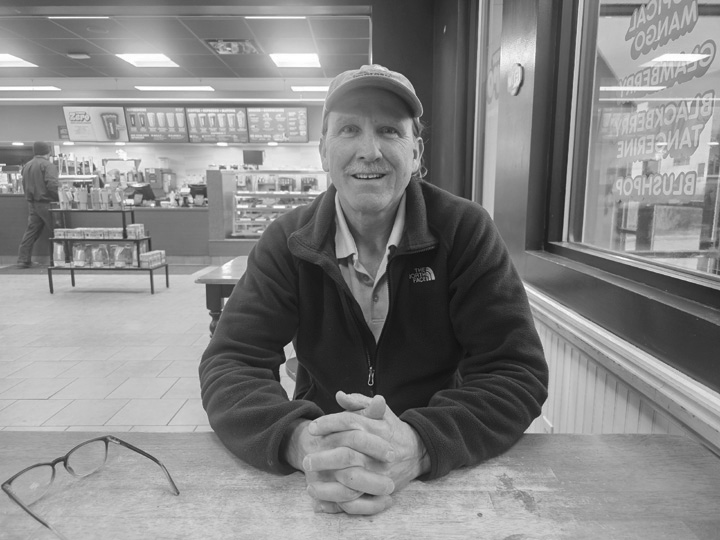
David Bradley opens Impressive Marine to service electrical and electronic systems.
David Bradley opens Impressive Marine to service electrical and electronic systems.
SEARSPORT – For those that can remember back 15 years or so, you might remember Bradley Boats, a boatbuilding company that operated out of Ellsworth by David Bradley. Unfortunately, when the 2008 financial crash came it took down this company. Afterwards I briefly saw David at Atlantic Boat and then at Al Pettegrew’s before he disappeared. Maybe once a year I would get asked if I had seen him. About a month ago he resurfaced. His company, Impressive Partners, was building houses out on Islesboro for several years, but now he is focusing on a comeback in the marine world with Impressive Marine, which does electrical and electronics work on the mid-coast.
“When I started the construction company,” said David, “it was after Covid. I was at Duck Trap Fish Farms in Belfast as a maintenance supervisor, which was pretty good, but I needed to do something else. I survived Covid working for them. I was thinking of starting a web-based electric motor sales company. Electric motors are everywhere. At Duck Trap I learned that because we’d go through electric motors like they were candy, but that didn’t happen. I then bought a trailer and threw an ad on Craigslist, because I just wanted something different to do. All of a sudden, I am getting carpentry work and getting paid really well. I do everything by the book; everybody has a W-2, all covered by insurance, all safe by OSHA standards. I try to maintain that level. It costs a lot, but I’ve got happy guys. It is amazing you could make a living with a chop-saw and a trailer. It was really good.”
Out on Islesboro he began by assisting another contractor with studding up a very expensive summer home and then he did the finish work. Now, he just finished up a boat house for the same owner. They have also been doing other jobs on the mid-coast and was getting ready to start a kitchen the next day. David added, “For me, it has been educational, because I am not a carpenter. I am a woodworker. At Bradley Boat I was able to take my ideas and put them in auto-CAD. Then we were able to transcribe that into wood and then moulds. We built parts that fit in the hulls. I had the greatest pride in that because we were able to take the first Bar Harbor 39, which took us about 12,000 man-hours, the second one took about 8,000 and the third one was around 4,000. My idea was to turn it into a production level boat.”
Unfortunately, like everyone, you realize that there is a point when the body says, ‘you cannot keep doing this.’ He was working with another contractor, and he will keep his guys busy for as long as they want to be busy. Now he is focusing on his marine business.
David grew up in Norridgewock and built his first boat when he was 8. He said, “I sure ticked my old man off. He had a piece of ¾-inch plywood, and I nailed some 2 x 6s to it and brought it out to the puddle in the front yard in the springtime and it promptly sank. I grew up on a lake in Northern Maine in the summers. My father had a flying service so there were always boats. I had an older brother who was a lobster fisherman of sorts and he built a wooden boat. He lent me Gougeon Brothers book. Every time I see one I buy it, and I give it to somebody who wants to know about fiberglassing. It is the Bible. In the back of National Fishermen there was always these ads for boat kits. I actually bought some plans, but of course I did not have the funding to build one.”
David then went to work for Robert Peire, who at the time was building the Indian Island 28 in Lincolnville, which was based on the BHM 28. He worked there for a short time but continued to read books on boatbuilding. David then got certified as a SCUBA diver and went urchin diving for the next 11 winters. During the summers he went lobster fishing as a sternman for Jeff Eaton of Deer Isle/Stonington for a couple of summers. David stated, “We had a great time. It was meet at the restaurant at 5 o’clock, get on the boat by 6, and go to work. I am not a lobsterman. It is a lot of going around and around and a lot of changing water in the traps. It was a break between urchin diving, and it was on the ocean. Nice clean air and I was making decent money. Then a couple of winters I worked with Jeff in the shop. One winter we rebuilt a Stanley 36. I can’t remember the gentleman’s name we worked for, but we tore it right down to the bare hull and built a new top. The next winter we built his HELEN ARLENE, the 38 H & H.”
When asked how they learned more about boatbuilding, David explained, “If we had questions we’d go drive off and see somebody who was doing something that we wanted to know. Jeff was really comfortable with the guys down at H & H. Eric at H & H helped us both out incredibly. We also went to the finish shops locally.”
David then went to work for John Hutchins over at Downeast Boats & Composites in Penobscot. He also got to know Spencer Lincoln and David added, “He would drag me off now and then and we’d go to different places and lay under a boat. He’d show me the lines, and he’d talk to me about them. I’d stop at his house, and he’d throw open the prints on his desk and he’d say, ‘You see what this is here?’ I had no idea, but I learned a lot from that man. He got me the job over at John Hutchins. I lasted there a year, which is a long-time doing finish work in a layup shop.”
At that point he decided to go out on his own and thus started Bradley Boats. “It was the right time. There were no finishers for all the hulls that were being built on the coast, and I immediately had three boats to build. The hardest part was finding crew and getting people to stay. Honestly, over the course of the tenure of Bradley Boat I had over 100 employees in 9 years. It’s a tough industry. You kind of have to nurture everybody that you get through the door because for one, they really don’t know what they’re doing and two, they really want to build a boat. It is not about grinding fiberglass or doing layup or spraying gelcoat.”
David did some things that others stayed far away from like fly-by-wire steering. Or taking the keel off of a Wesmac 38. He said, “That was a no, no. The first one I did I had an incredibly hard time with. We built it with such a high center of gravity that it would trip on its keel and fall over. Basically, when you turned to the left it would lean over to the right. It would scare you. You could see the S-turn in your wake. That was my fault because I did it without doing the proper weight and balance calculations and by removing the keel it changed everything.”
David liked the 38, which he called the Bar Harbor 39. He added, “That is a nice boat. I bought the hulls from Wesmac, but I had them block out the keel. We glued a piece on the bottom of the hull to run the shaft tube through. It is just basically for rudder and prop protection. I was on one of my boats sleeping down below. It had been a really rough night, and the owner was at the helm as we were coming in Barnegat Inlet in New Jersey. He got on the top of a wave and got into the chop and hit a sand bar. It sounded like it ripped everything out and inside the boat was a mess. We hauled it out a couple of days later and I couldn’t see anything. I put stainless steel skeg shoe on the bottom of it, and it had a little scratch. That was a great test.”
“I really didn’t know what I was doing when I started Bradley Boat,” confessed David. “I had an idea; I guess you could call it a dream. I just wanted to do it better than somebody else. I wanted to make nice things. I think we built nine in the 38-foot range and 30 of the little 22-footers. The 22 was a Calvin 20, which came from Northern Bay. Somebody took a 20 and stretched it three feet and he started making them and calling them the St. Croix 22. Eventually, I bought the mould from him, and I then sold the molds to Al Pettegrew. He calls it the Black Ledge 22, but I don’t know if he’s ever done anything with it. I built new deck and cabin moulds for it. It really is a sweet little boat.”
When it all came crashing down, David had a boat in the shop, which he moved up to Brewer, where he finished it off. When that was done, he went to work for Atlantic Boat for about a year. He did a lot of work on the Flye Point 31. He said, “They were trying to build a production run for the 31-footer. I did a lot of work on that and the advertising and this and that. I am not sure where it all went. I put a lot of effort into that.
“At that point,” continued David “I went around the yards. I worked with Al Pettegrew for a year or so. Then I went over to Wesmac, wiring and stuff. Really nice boats. Then from there I went to Anguilla in the British West Indies for three winters. I worked pretty much as a maintenance guy for a ferry operator who had 11 of these classy looking outboard boats he was using as water taxis to get you across the bay to Anguilla the first year. They were running all the time and so I worked on his boats. Before I left one of the owner’s friends said he wanted to build a boat. He was in politics, but he ended up with this boat shop. They started from scratch and he built stitch and glue, plywood, glass over plywood and mahogany West System boats. They worked in open bays with the wind blowing through. So, we had the hull, a 54-footer, and I turned it into a 50-passenger ferry. The first air-conditioned cabin ferry for the island. She had a pair of C-15 Cats in it, and it went really well. I was really proud of that. We worked with Donald Blunt and a guy named Chris, both from Rhode Island. They designed a proper drive train and then we went from there. The second time around they were really necessary because we put the props in tunnels. It was a really unique experience going from hull to Coast Guard sea trials in six months. I got a call three or four months later that one of the captains had got upset and burned her right to the waterline. They had it in the yard when I went to visit and it was gone. So, we had another hull built and I went down and did it all over again. It wasn’t as much fun this time around.”
David was doing this during the winters and in the summers, he would return to Maine and work with Commercial Divers’ Inc. out of Bangor. They were working on dams and power plants. He then went to work for a New Hampshire company, which was working on high pressure steam valves. They would disassemble all the valves and put them back together and David would certify them.
He then went to work for a company based in St. Thomas, which worked on MTUs. The majority of the work was on land-based generators. When a hurricane came through, they had plenty of work getting everything back functional. He was also working on mega-yachts. “I liked working on the big boats,” said David, “and all the people were great, but it was a long way from home, and six months is a long time to spend from home.”
He enjoyed it all, but he wanted to come back to Maine. Before Covid and the tariffs, David was buying obsolete electronics online and repairing them and reselling them. But when the prices went up it became hard to make a profit. David added, “I am 62 and when Bradley Boat went down, I lost everything. I lost my own personal respect, and I lost the respect of a lot of people when I went out of business. I spent four or five years just trying to gather myself back. It took me a long time to get back into the marine thing mentally. I know where I belong, it’s with boats. Everything about my life has been really revolving around boats. I think the electrical, electronics thing is fun. It challenges me and I can make people happy doing it. I went down to Rhode Island two years ago and took all the MEAs on networking and electronic installation. I study ABYC steadily and keep on top of that. If there is a question, it is in the book I carry. I don’t hold any ABYC certifications, but I will. I am an authorized dealer of all of those electronics, and I have done training sessions with some of them. I wanted to get back into something that I love and enjoy. Just with the sales end of it I should be able to survive and doing installs at my leisure as I get older. I have taken all of my retirement money and put it into this new venture so hopefully it will return on my investment.
There is a huge demand for marine electricians and electronic technicians anywhere on the coast of Maine. David will not have a problem finding work, his problem will be can he handle all that comes his way. He certainly will try his best.