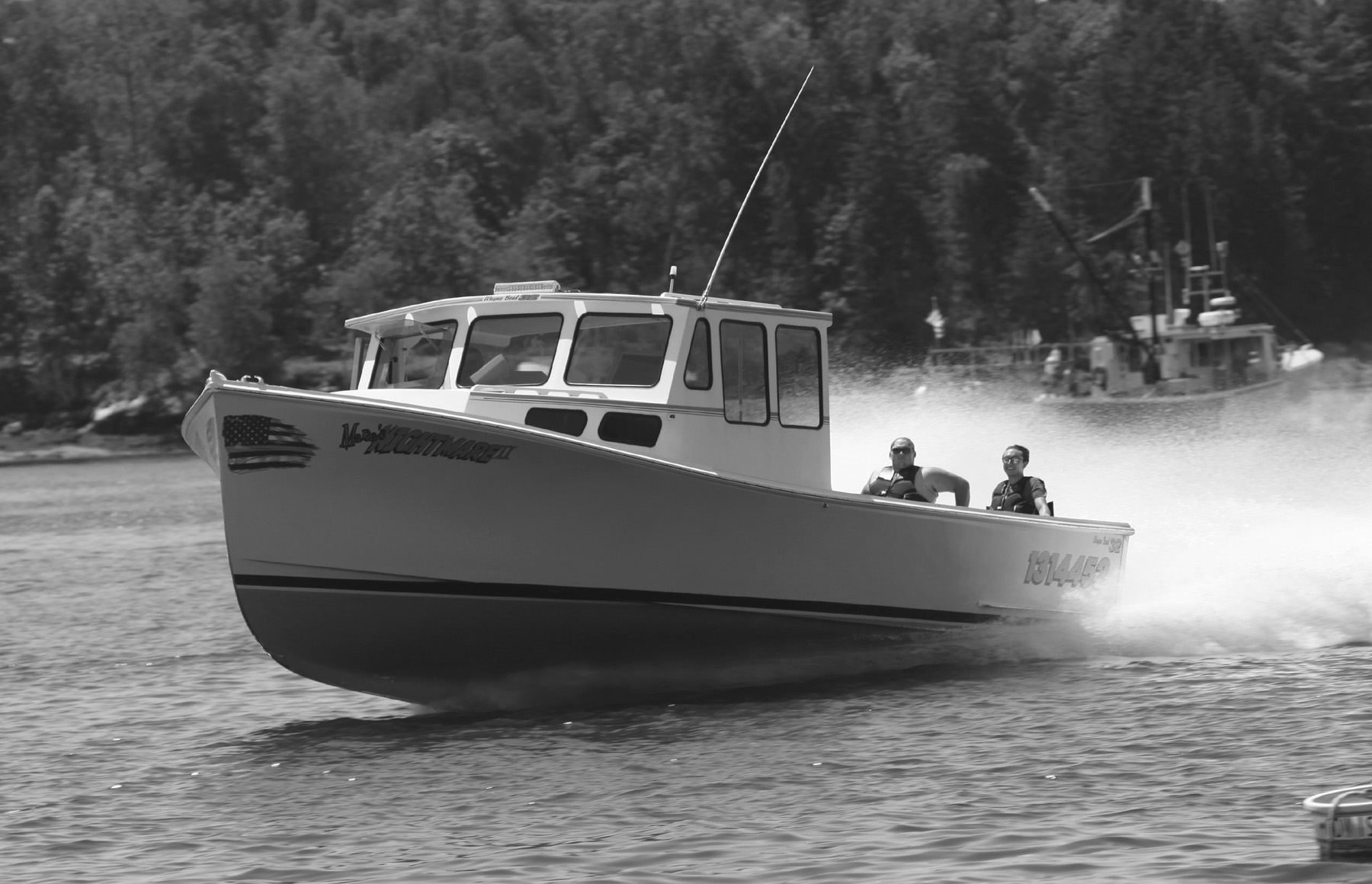
This is a Wayne Beal 32, powered with 1,000 Isotta, capable of speeds over 65 mph.
JONESPORT – One of the most prominent boatbuilder names in the State of Maine are the Beals of Beals Island and Jonesport. Over the last one hundred years there have been a number of them who made a significant name for themselves. One of them that is still carrying on the tradition is Wayne Beal, who is the younger brother of Calvin Beal, Jr.
I first met Wayne at his shop on Ice Hill Road South in the late 1980s. In 1984 he put up a deck floor in a make-shift building. He added, “That’s when Calvin got a chance to do the South Shore boats, so I had the first. I don’t know but it was the first three 30s that South Shore did. I started out with a spec boat and sold it to Tom Watson over in Cundy’s Harbor. Then the next one I think was mine and I sold it to my father. Then Jeremy (Wayne’s son) had it for a while and then it went over to Mill Pond on Beals, Dean Alley’s got it now. The next 30 I did went to Allen Carp. He was the guy that tried to sell boats out in New York. He got tangled up with us and he had a friend that wanted one, so, I finished it off for him. That one went down to Long Island. After that I got together with Calvin, Jr. in 1990 and did the 36.
“Well, what that started out as,” explained Wayne, “I was going to do a 38. We had the half model built, had the stern built and we were getting ready to do the keel. I think all the moulds were built and we were getting ready to set them up. Ordman Alley came in the shop and he said, “I don’t want that big of a boat,’ he says, ‘What would it take to get you to change to a 36?’ I said, ‘Geez, we have got this here started.” If I was going to do anything like that, I would have to have two firm orders, and we will do the change.’ He rounded up Larry Crowley and both of them put orders in. We took the stern for the 38 and cut that down to a 36. What I did, I helped Calvin, Jr., he was building a Crowley 36 at the time. I told him I wanted it a foot wider. I wanted concave in the bow, and I wanted to raise her up. So, I worked with him, made the changes, and drew up the 36.”
We both remembered the issues they had getting the first one out of the mould. Wayne explained, “We had a lot of zero weather and all I had for heat was one of those little trailer furnaces. Everything was done right, except for the heat. The boat was upside down, the keel came out good, but everything else stuck. Down near the floor she didn’t hardly hardened. After a while she did, but it was just slow cure, because the cold broke the wax down. It was all to do with heat. What we did was Calvin, Jr. had some oak timbers over there, so we split them and wedged them out and drove them right down around her, broke her clear of the mould. We just tore it to pieces trying to get it apart. Pulled chunks out of the mould, pulled chunks out of the boat, but it was all gel coat damage. The only thing with the mould, we had to force her so much to get her apart that it ended up with stress cracks in the turn of the bilge where the garboard and the keel meet. If you look at the mould it looks like a patchwork quilt. The cracks kept coming out, but we just repair them. We have hauled 110-115 boats out of it. It has held up well.”
“That was the start, continued Wayne, “well, it wasn’t actually the start. My start was in the 23. Calvin made up a half model, and I had Dana Perley working with me. He and I took her right from the half model and built the boat and the mould. That was my initiation into fiberglass boatbuilding right there.”
Wayne had done wooden boatbuilding with Ernest Libby, Jr., and Calvin. He said, “I had worked in the boat shop when Ernest Libby, Jr. was building wooden boats when I was in high school. I used to go down there and do odd jobs. He used to hire me in and we swapped labor. When I was in high school, I had a 21-foot outboard boat. I helped putty and painted the cabins out and stuff like that. He paid me back by setting that boat up, made up the stem and stern and the moulds and set her up. Then Calvin, Jr. and I planked it and built her up. I fished out of that while I was going to high school. I helped Ernest Libby, Jr. build the 38 Young Brothers plug. Then I helped build Alan Beal’s 36 that Tommy Beal ended up with and that was a 36 that Ernest, Jr, was building. I worked with him until I went in the Navy. We planked her up; the shudder plank went in on the Saturday before I left on Sunday to go to the Great Lakes and boot camp.”
When Wayne returned from the Navy, he worked with his brother Calvin and then with Herman Backman, Jr. Herman at the time was fiberglassing dories for the seiners. Then he had a boat started for, well I don’t know if he was doing a spec boat or if somebody had backed out, I am not sure, but Jerome Crowley ended up with that boat. Then it was getting toward spring, and I wanted to go worming so Ralph Davis, Sr. worked with him and helped finish it off for Jermone. After that I used to work winters with Calvin.”
He and Calvin lobster fished during the summer and fall and then it was back into the boat shop.
With the 36, Wayne would have three or four orders and that kept him busy all winter. Then he bought the 28-footer LITTLE GIRL, which was designed and built by Calvin in 1981. “I bought that off of my brother Dean,” said Wayne. “Of course I changed it to what I wanted. I put a three-inch batten on top of her and shoved it out on the flare. I had the 23-mould operational, so I went out there and laid up a section of glass out of that flare. I made it about eight or nine feet long and two feet deep and fastened it to the top of the LITTLE GIRL. It laid around her just like a glove, so, I just nailed it on with sheetrock nails and took sheetrock mud and faired it in. I had to lengthen it on the back end so it would blend into the side of the profile of the boat. On the sheer line, I wanted to be a little higher down aft, so I just shimmed it up and I raised her another couple inches down back. That was the 28.”
Jeremy said that they added three or four inches to the 28. Wayne continued explaining, “Otto Proctor cut that for me, and I helped him get the keel setup. What it was, LITTLE GIRL didn’t have the clearances I wanted so we went in and cut the keel. Then we lined it up for the pad for the stuffing box, so she’d handle more prop. We knew that she was going to have more power. The old wooden boats were fighting for clearances because it was a hard job to get the clearance big enough to really do a good job.”
The 36 came out in 1990, but Wayne did not remember the date for the 28 as all his records were lost when the shop burned.
Next came the 34, which they made the same modifications to. They made a splash mould and got a hull out of that. They then faired it and took a mould off of it. The splash mould went to Jim Preston in Rogue Bluffs who finished it. She went ashore and suffered a lot of damage. He hauled her up in his yard and Wayne thought he made the needed repairs and re-launched her. He used her as a scallop dragger.
After the 34 came the 40. He said, “I decided I wanted to put a 40 in the line, so I went over and talked to Calvin, Jr., but he wasn’t right sold on it. I wanted kind of a semi-built down. We could have a little more room under the engine since a lot of them want the engine under the floor. I also wanted her deeper forward and that made her fair through so much easier. You look at my 40 compared to Calvin’s 42 and she is quite a bit deeper, probably eight inches. So, I told him the dimensions I wanted. She finished up about 15½ and a touch over 40.”
When the shop burned Wayne lost the 40 mould along with the mould for the washboards and patterns. Wayne said, “Fortunately the plug I had out here in the bushes. Of course, the weather had been working on it, and she started to rot where the back end of the keel went onto the hull. So, we repaired the skeg and where she was coming apart a little bit. Then I got thinking it over and thinking we probably ought to build a 42 instead of a 40. The 42 was more to what the guys wanted and the 40 was a little stubby on the house. The 42 is a better-looking boat.
“As for the 46,” continued Wayne, “I took a 40 and cut her up and made the 46. What we did was lengthened her first and got her, so she was all faired and then made a two-piece cradle and set her in it. We had it so the divide was going to be between the two cradles. We came ahead of the backing piece just a little bit, probably about three feet ahead, so we got clear of the fairing and cut her right across. Then we rolled her two parts open, measured her up, lined up the water lines with the water level, and built her back in. I wanted her quite a bit wider, so we opened her up a foot on each side. I went in under the turn of the bilge and when she flattened a little bit, I cut her right there. We stopped back behind the stem; I think it was eight feet from stem. She trued right up. That was pretty simple and all we had to do was repair the outside.”
“When we did a 34,” continued Wayne, “I come near doing a chine boat right there, but I didn’t know if they were quite ready for it. We bolted rails on all the time and poking these hull solid full of holes wasn’t a good idea. Plus, they get rope cuts or knock them off on floats or something.”
Next, they did a 50, but they did not make a mould and that is the only one.
Where are the moulds now? The 23 was sold to Don Crowley and then went to Beal’s Boat Shop in Milbridge when Don joined them in the 1990s. Now, Sargent Custom Boats has them. The 28 went to Hutchinson Composites in Cushing, but recently they were sold. The rest of the moulds that survived the fire are all at Wayne Beal’s Boat Shop.
What is interesting is those that spend hours and hours with the best software available to design the boats of today. However, listened to some of the old builders, who learned from the older builders as the design information was passed down. It all ends up as to just what is the boat going to be used for as there are compromises. Since most of these builders also fished with their boats, they knew just what their characteristics were and could steer a customer into a better boat. The boats Wayne designed and produced are boats that are good sea boats but also would push through the water easily. They are certainly some of the best offered in this market.