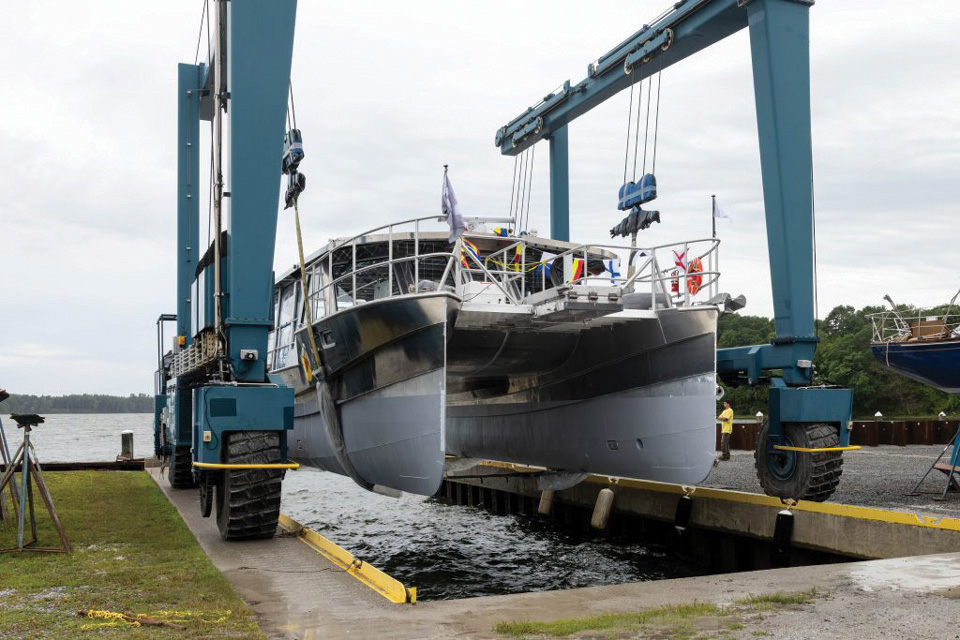
The 49-foot aluminum catamaran FIREFLY waiting to be launched at the Lyman-Morse yard in Thomaston. She was built at their Fabrication facility in Rockland.
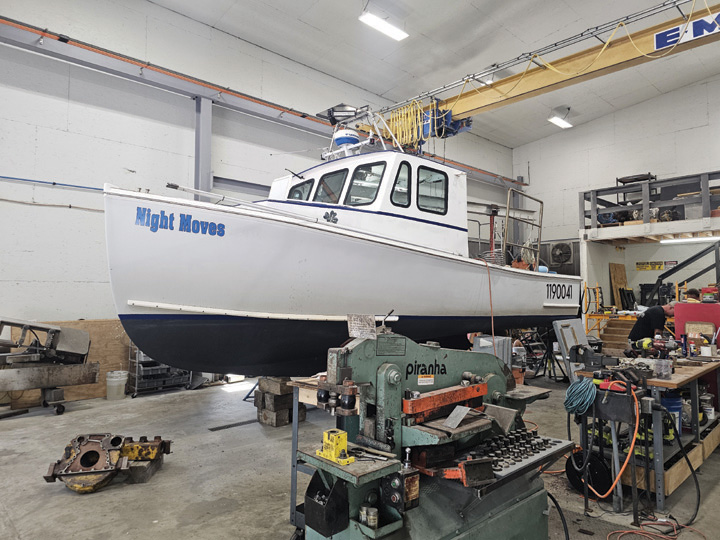
This is the lobster boat NIGHT MOVES having her engine rebuilt at Long Cove Marine on Deer Isle.
Front Street Shipyard, Belfast
Tactical Composites Delivers First Autonomous SHARC Prototype to U.S. Marine Corps
The 38-foot unmanned amphibious logistics vessel was built and launched at Safe Harbor Front Street in Belfast
Tactical Composites, a Bristol, Rhode Island-based advanced marine manufacturing team, has delivered the first prototype of its autonomous SHARC (Small High-Speed Amphibious Role-Variant Craft) to the U.S. Marine Corps. The SHARC represents a bold leap forward in expeditionary maritime capability as an original, cutting-edge autonomous logistics platform designed to redefine how critical payloads are delivered in the world’s most complex and contested environments. Constructed at Safe Harbor Front Street in Belfast, Maine, the prototype vessel was launched and successfully sea-trialed in April 2026.
Developed under the U.S. Marine Corps’ SBIR Program, the SHARC is an autonomous expeditionary vessel designed to move troops, equipment, and essential supplies into challenging, high-risk environments. The catamaran is 37.75 feet long with a 13.45-foot beam and 2.41-foot draft. An automated bow ramp is engineered to deploy heavy payloads directly onto beaches or into the water when conventional port infrastructure is unavailable. Powered by twin 300-horsepower OXE diesel outboards, the SHARC carries up to 14,000 pounds of payload at a 20-knot cruise speed, with a maximum loaded speed of 25 knots in moderate (Sea State 3) conditions and a range exceeding 1000 nautical miles.
The SHARC was developed and built by a multidisciplinary marine innovation team: Design: Mode 3 Design; Construction: Safe Harbor Front Street; Engineering: Waterfront Composite Solutions; Autonomy Systems: Robosys Autonomous Marine Solutions; and Electronics: Cay Electronics Inc. and DQ Yachts Inc.
Military mission profiles for SHARC include autonomous delivery of supplies such as food, water, fuel, munitions, and autonomous systems to contested shorelines where traditional harbor access may be compromised. Additional envisioned uses include launch and recovery of autonomous underwater and aerial drones, casualty evacuation, delivery of unmanned ground vehicles, and distributed autonomous swarm operations alongside other unmanned systems.
“The future battlefield demands logistics solutions that are resilient, adaptable, and capable of operating where traditional infrastructure is unavailable,” said Rich O’Meara, principal at Tactical Composites. “The SHARC was designed from the outset to be mission-flexible and capable of evolving with operational needs.”
SHARC’s autonomy architecture is intentionally open, enabling integration with a wide range of perception hardware—including cameras, radar, GPS, sonar, and other sensor packages—as well as interoperability with compatible open-architecture autonomous systems.
The vessel’s dimensions also allow it to be transported over the road on standard equipment, including low-boy trailers, which is an important operational advantage for rapid deployment. A wide width permit is required for shipping.
Built using advanced composite manufacturing methods, the SHARC hull is vacuum-infused fiber reinforced plastic (FRP) utilizing U.S. Coast Guard-approved fire-retardant vinyl ester resin and foam core construction. The deck is reinforced with carbon fiber and includes multiple payload tie-down configurations, along with alloy rail protection for tracked cargo. The automated bow ramp is engineered to support the full 14,000-pound payload even under cantilevered loading conditions.
The vessel is a scalable platform, allowing upgrades to both payload and autonomy systems to support evolving mission requirements. Future variants are already in development, including a larger vessel based on the same manufacturing and logistics concept. Additional production units are already on order for delivery in 2027 and 2028.
The U.S. Marine Corps will sea trial the SHARC and perform autonomy validation, payload testing across varying sea states, and operational demonstrations with U.S. military users throughout summer and fall 2026.
Beyond defense applications, Tactical Composites is also evaluating commercial opportunities for both the vessel platform and its autonomous technology stack, including offshore energy support, wind farm servicing, remote island logistics, and personnel transport.
With a target production cost of approximately $1 million per vessel, Tactical Composites plans to leverage modern manufacturing partnerships across U.S. shipyards, with international production potential over time. Interested buyers should contact Tactical Composites via the website at tacticalcomposites.us.
Tactical Composites designs and manufactures next-generation advanced composite solutions for the armed forces of the United States and its allies. Its innovative portfolio includes enclosures, rigid-wall and truck-mounted shelters, flat-pack buildings, and a wide range of amphibious, marine, and autonomous vessels. Engineered for the most demanding expeditionary and combat environments, Tactical Composites’ products are designed to enhance mission readiness, survivability, and operational resilience.
Tactical Composites’ advanced composite shelters are designed to offer protection against electromagnetic interference (EMI), electromagnetic pulse (EMP), and fire smoke and toxicity (FST). Headquartered in Bristol, Rhode Island, Tactical Composites is a division of ROM Innovation & Development LLC. For more information, visit tacticalcomposites.us.
Long Cove Marine, Deer Isle
Engine businesses are usually extremely busy all year around and at times it can put boat owners in a bad position, especially if they make a living from that boat.
There were two boats in having major engine work done. The lobster boat THUNDER STRUCK of Stonington was in to have her 265-hp John Deere rebuilt. They would also go through the power train making sure everything was at should be. They said on this project they would be replacing the cutlass bearings, a leaking hydraulic pump, and hoses as needed.
Next to her was the lobster boat NIGHT MOVES from Isle au Haut, which is powered with a 225-hp John Deere engine. That has been removed and will be a bare block rebuild. Again, they will be replacing the cutlass bearings, hoses and cleaning up all the corroded parts.
A local fisherman from Stonington brought in a 750-hp John Deere to be rebuilt. The owner had purchased another boat, which was powered with an old Lugger, and he will replace that with the rebuilt 750 John Deere.
Outside is the lobster boat FALL LINE from Swan’s Island. They went to Swan’s Island to do a service call on her 420-hp FPT engine and discovered that oil was coming from the antifreeze reservoir. They thought this might be due to a faulty oil cooler, but when they pulled that off, pressure tested it they found nothing wrong. Then they thought maybe the head. They pulled the head and sent that to Bangor to be checked. They are hoping that this is the problem. There are a number of these engines on the coast, and no one has seen this problem before.
They also did work on Jason Knowles’ new boat, which is powered with an 800-hp MAN. They installed the engine and shaft and then did all the hydraulic work.
There is a 46-foot boat at Oceanville Boatworks in Stonington, which they will be doing all the plumbing on. They just finished another job there on a boat that had her fuel tank in the keel with the shaft running through it. It had ruptured on the outside, so they removed the tank and put it up under the platform. They then glassed her up, installed a new cutlass bearing and plumbed everything.
They do a lot of oil changes going though about 1,500 gallons a summer. They will send somebody down to the boat when they know that they will not be going out that day. The advantage to having an engine mechanic do this is that they look around to see if there are any other issues that have not been discovered. This could save a lot of aggravation and money in the future.
Not only has engine rebuilding kept them busy, but they have been rebuilding a number of gears. In fact, they have a building that they are turning into a transmission shop, which should be ready before the snow flies.
There was a slight slow-down this summer, but that gave them a chance to clean the shop from top to bottom, which they said desperately needed it.
Lyman-Morse, Thomaston
Meet the New Hood 42 LM
Every so often, a yacht emerges that reminds us why people still believe in American boatbuilding. The new Hood 42 LM is one of those rare projects — a yacht that embodies the artistry, innovation, and uncompromising craftsmanship that have defined Lyman-Morse for nearly 50 years. From her timeless C.W. Hood-designed New England profile to the extraordinary hand-built details discovered throughout, she represents the kind of singular, owner-driven project that has become a hallmark of our yard. She isn’t simply another beautiful boat. She’s the latest expression of what can happen when exceptional design meets the collective talents of master craftsmen who refuse to compromise.
From a distance, she’s unmistakably a Hood. Graceful lines. Varnished mahogany. Bronze accents. The kind of timeless New England profile that never goes out of style. But spend a few minutes aboard, and you’ll discover what truly makes this yacht special.
Every inch reflects the hands and minds of the people who built her. The hidden electronics console. Custom-forged bronze hardware created specifically for this boat. A carbon-fiber companionway door wrapped in beautifully varnished wood. Power windows that disappear with the touch of a button. Hand-shaped joinery that feels more like fine furniture than cabinetry.
Beneath her classic appearance is equally impressive performance. Built using our cold-molded composite construction, the Hood 42 LM is remarkably strong, light, and quiet underway. Twin Volvo Penta engines provide effortless handling, joystick maneuverability, outstanding efficiency, and cruising speeds in the mid-30-knot range—bringing modern technology to a yacht that looks as though it belongs to another era.
Inside, the atmosphere is warm, sophisticated, and inviting. Rich mahogany, sculpted cabinetry, and abundant natural light create a space that feels more like a beautifully crafted retreat than a production yacht. Every transition, every locker, and every finish reflects the same philosophy that guided the entire build: nothing is overlooked.
While Hull No. 1 showcases one owner’s vision, the Hood 42 LM was designed as a platform for future owners to make their own. Multiple layouts, flybridge or sedan configurations, and nearly endless handcrafted customization ensure that each Hood 42 LM will be as unique as the people who own her.
The Hood 42 LM continues the successful partnership between Lyman-Morse and C.W. Hood Yacht Design, combining timeless proportions with modern engineering and the craftsmanship that has defined our yard for nearly 50 years.
If you’re attending the Newport International Boat Show, September 17–20, we invite you to step aboard. Photos simply can’t capture the level of craftsmanship, the warmth of the interior, or the countless details that make this yacht truly exceptional.
Lyman-Morse Launches Groundbreaking Solar-Electric Passenger Vessel FIREFLY
The first fully electric, lithium-ion-powered Subchapter T passenger vessel will serve as a floating classroom for education nonprofit Upstream Alliance on the Delaware River.
Last week, we proudly launched Firefly, a groundbreaking 49-foot aluminum catamaran built by Lyman-Morse Workboats for Upstream Alliance. As the first fully electric, lithium-ion-powered passenger vessel built to meet U.S. Coast Guard Subchapter T requirements, Firefly represents an important milestone not only for our team, but for the future of sustainable commercial boating.
Designed by Gerr Marine, Firefly is powered by twin Electric Yacht QuietTorque motors, advanced lithium-iron-phosphate battery banks, and 24 bifacial solar panels that help recharge the vessel while underway and at anchor. Integrating electric propulsion, energy storage, solar generation, and Coast Guard-certified passenger vessel systems required close collaboration between our aluminum fabricators, electricians, mechanics, systems technicians, and commissioning specialists — demonstrating the value of having so many disciplines working together under one roof.
Firefly was built for a mission that extends well beyond transportation. Once delivered to Camden, New Jersey, she will become a floating classroom, environmental research platform, and community resource on the Delaware River. Operated by Upstream Alliance, the vessel will introduce middle and high school students to river ecology through hands-on learning, water-quality testing, scientific research, and conservation programs. She’ll also support community organizations, environmental initiatives, and educational expeditions that help connect people directly with the waterways they’re working to protect.
We’re thrilled to have built a vessel that pushes the boundaries of marine technology while helping educate the next generation of environmental stewards.
Following the early-August launch, Lyman-Morse will conduct dockside commissioning and sea trials to verify Firefly’s propulsion, battery, charging, navigation, safety and onboard operating systems. After testing and regulatory requirements are completed, the vessel will begin its delivery journey from Maine to its new home on the Delaware River.
Morgan Bay Boats, Swanville
Two years ago, they pulled the first Morgan Bay 47 out of the mould. They made modifications to the 43 making her four and a half feet longer and gave her a different sheer. The sheer at the bow is six inches higher, eight inches amidships and four inches at the stern. Since that time, they have installed everything under the platform as well as most of the interior is in down forward. The extra length allowed for a separate stateroom forward with an island double berth, guest stateroom to starboard and a head with enclosed shower to port. Up in the shelter the sole is down, but they have yet to build anything, as the designs are yet to be finalized. As for power she has a 1,150-hp C-18 Caterpillar.
They are now waiting on the deck, which they had to make a new mould for. This was being laid up in mid-August and should be completed early September. The big change here is that the windshield was moved back three and half feet from where it is on the 43 and that coupled with the other changes to the hull made the 43 deck mould obsolete.
They hope to have this one over in the spring. They have interest in another one, exactly like this one, but they want to get this one in the water and make sure everything goes as it should before they take on another one. The only change they may opt for is to change the engine to a 1,450-hp V-12 MAN. They liked the horsepower, smoothness and how quiet it ran.