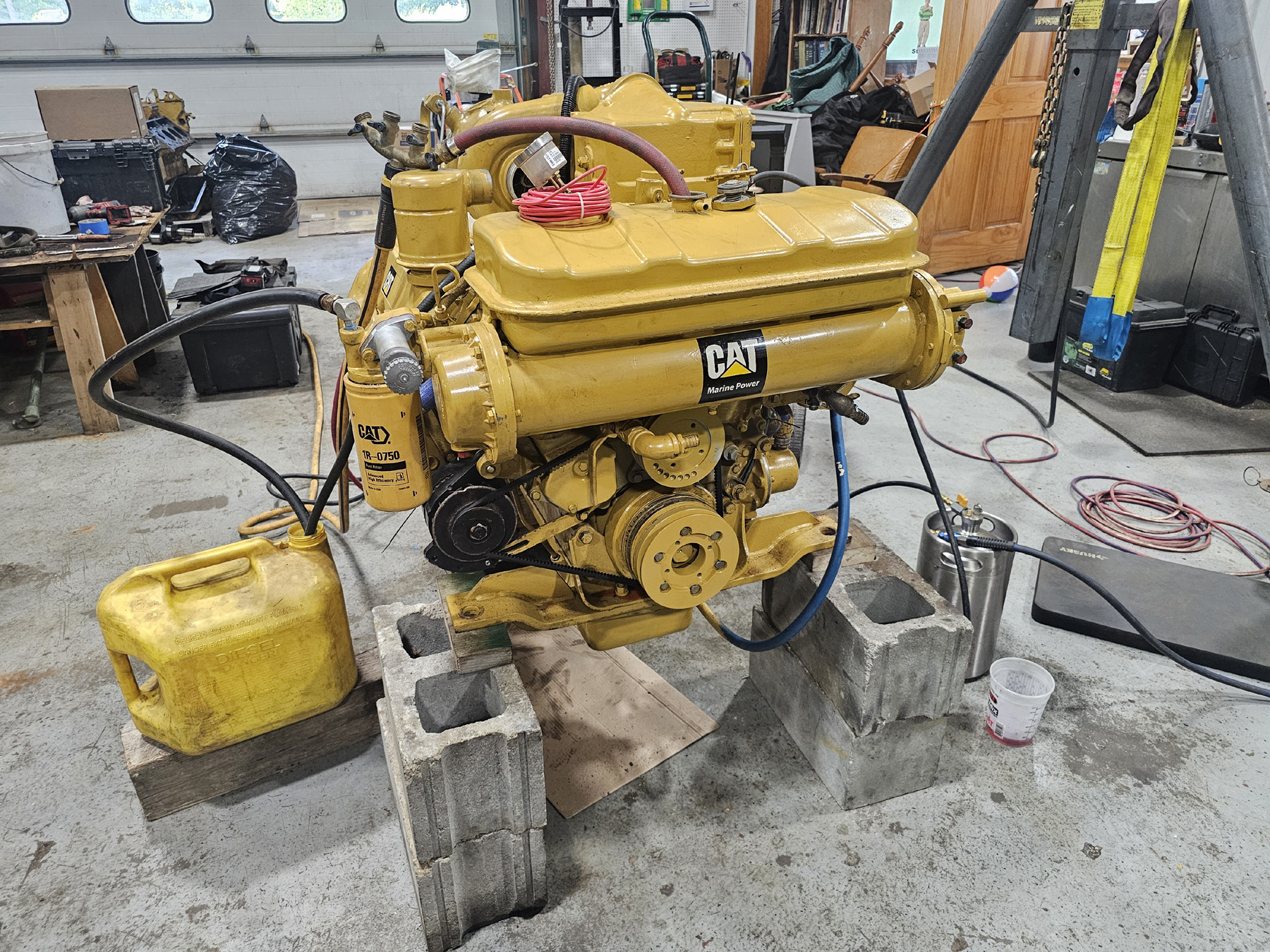
This is SARI ANN I 375-hp 3208 Caterpillar after her total rebuild at Rockfleet Marine in Ellsworth. It was thought she suffered a major failure due to fuel issues.
SEARSPORT-BELFAST-ELLSWORTH – There are a number of sounds that can be very unnerving when running a boat. SARI ANN I is a 40-foot wooden boat built by the John’s Bay Boat Company of South Bristol in 1998. She was built for well-fisherman Vance Bunker of Owl’s Head, who at the time fished off Matinicus. She is powered with a 375-hp 3208 Caterpillar Diesel engine, which has performed perfectly over the last four years.
Just after leaving the dock at Searsport for a cruise down Penobscot Bay, she headed out the anchorage and suddenly developed a rapping sound. Immediately she was headed back to the dock where a quick assessment was made. That assessment was to call an experienced diesel mechanic as this was not a quick fix, it was serious. I called Glenn Crawford at C & C Machine in Ellsworth for some insight, and he said he thought Troy Morey, owner of Rockfleet Marine, LLC next door might be available. I called Troy and he said that he could get there the following morning. Troy explained, “The first thing we did was take the valve covers off and rolled the engine around to do a valve check to see if there was a tight valve. In the process of rolling it over we found it rolled over extremely hard. It took two of us with a two-foot Stilson wrench to roll it over. That alone was a big red flag that something was not right. We did a quick check of the valves, and everything seemed okay. Nothing was tight like a valve pushed up into the head. So, we then decided to take the oil filters off, bring them back here to the shop, cut them open and take the filter paper out. They were full of metal, which only meant something deep in the engine had failed. That is when I said, “We probably need to take the engine out of the boat and take it apart as it probably has a piston/block issue or a crankshaft issue.”
The boat was hauled out at Front Street Shipyard and set in Building #5. Jeff Hanley from John’s Bay Boat came up and opened up the back of the house so the mechanics at the yard had an easier time getting the engine out. In a couple of days, it was out and in the back of my truck and heading for Ellsworth.
“Well, the first thing we did is drain the oil out and took the pan off,” continued Troy. “Once the pan was off, we saw how much metal was in there, a lot, big chunks of this and that. I then picked it up on the overhead crane and looked up in the engine. As we rolled it over, I saw that number five and six connecting rods had beat the bearings out of it and the crankshaft was no good. So, now that we knew how deep we had to go, we put it back down on the blocks and Lorraine (Gee, his wife) and I just started taking it apart. She took one side and I took the other side, and we stripped it down, marking injector numbers, marking piston numbers, so we could go back later if we found there was an issue with a certain cylinder. We bare blocked the engine and found that the crankshaft was failed. The block had some scoring in it, so we took the cylinder heads and the block to the machine shop in Bangor to have it checked out, either to be honed or re-sleeved. The failed cylinders, five and six, were too bad to reuse so they bored them out and pressed an insert in to put it back to standard specs. As for the heads, one head was cracked and the other had been machined to the point where it wasn’t worth reusing. You took them two different heads, which passed and they rebuilt them. We also took the fuel injection pump to Diesel Fuel Systems in Bangor and told them the scenario. They dismantled the pump and in dismantling it they found that all the limiting screws and the fuel rack had been taken out and the check valves had been put in backwards to try and get more pressure into the pump. We assumed that someone was trying to get more power out of the engine. They believed that the pump was putting a little more fuel in the injection side of the pump and probably injector failing is what caused your failure. I didn’t have them test the injectors, but they can be tested later if need be. They just gave us eight new ones. We feel an injector had over-fueled the cylinder and the extra pressure in the compression of the cylinder firing probably took its toll on the rod bearing and that’s what ended up beating out of the engine and wiping out the rod bearings and ruining the crankshaft. Once they had everything stripped, they rebuilt the pump and put everything back to where it should be, all of the plungers and barrels, and set the timing for the horsepower of your engine. Cat doesn’t make new crankshafts for this engine, so we got a crankshaft from another dealer and had it checked at the machine shop. Everything was true and polished and then we put everything back together: new main bearings, anything affected by metal in the oil, such as oil cooler. The oil pump was all gone through and flushed and cleaned. Then we put new piston domes in, new rings, assembled the heads, everything we needed to do to get it back to proper running specs. Then we ran it here on the shop floor for a day just to make sure it ran at its proper RPMs. Then flushed out all of the assembly grit and assembly material several times. We also made sure it idled correctly. Then we painted everything the best we could, put it on a pallet and loaded it onto your truck.”
It was not long before Front Street Shipyard had the engine back in and over she went. Started right up and off she went to the Searsport Town Dock. Troy said to change the oil at about 100 hours, which will take place soon. Then we will go back to changing the oil every 200 hours and at about 500 hours he wants to do a valve adjustment to make sure things are where they should be.
Standard maintenance depends on how you use your boat. If you are a summer boater or a commercial fisherman that does not fish hard you should have the engine gone over in the spring. The oil should be changed; zincs replaced, belts checked and replaced as needed, the impeller should be checked and replaced if it has issues; replace the Recor filters, check for oil leaks and check the coolant. Coolant can get acidic so this should be changed when it tests acidic. When coolant gets acidic it can eat the liners out of an engine. In regard to oil some opt for synthetic, but if you are not changing the oil as frequently as one should, other maintenance items may be overlooked. Troy likes good standard oil. When should the oil be tested, he said every couple of years just to make sure nothing is happening that you cannot see. Valves should be adjusted around 2,000 hours. An after-cooler should be serviced every couple of years. Now, every engine is different, especially the newer electronics ones, so look up what the manufacturer suggests for a maintenance schedule. Make sure you log the maintenance into a logbook, so it is written down.
As for fuel, it is more raw today as it once was having less cleaners and cetane boosters. Troy suggests a conditioner. Some fuel is low sulfur and that does not lubricate the pumps well and conditions can alleviate that. In newer engines this is not a problem as they have been made to burn low sulfur fuel. Now be careful when treating fuel, because a large dose can kill algae and that will try to run through the filters and plug them up. If there is a lot of growth in a fuel tank have it professionally cleaned.
Every engine has its quirks so try to learn what they are so you can keep an eye on them.
Troy began playing with engines in his uncle’s gravel pit in Stonington when he was a teenager. He also loved driving big trucks, saying, “I went truck driving for 10 years, hauling hazardous material. My older brother, Will, works at Billings, so, I went over and gave that a shot. (His other brother works there in the parts department.) When I got there the guy doing Caterpillar work got done so I moved into the Caterpillar zone. I asked a lot of questions, made a lot of mistakes, learned from my mistakes and kind of became the Cat guy. I was there 22 years. Lorraine and I started this business July of 2021. We rented at Abel’s for a year and Glen (Crawford of C & C Machine) had this spot. We tear them down together, go through the cleaning process, make the parts orders, go and get the parts, put them back together and run them. When the little guy is big enough, he’ll be out here too I expect.”
Lorraine is from Ireland and she learned from her brothers who worked on big engines. She came over here and did a stint in the U. S. Coast Guard. She wanted to do inspections, but the list was too long to get into that program. She then took a position on the tall ship OLIVER HAZARD PERRY sailing out of Narragansett Bay in Rhode Island. Then she came to Maine and worked on a lobster smack out of Seal Cove before going to work on a whale watch boat for about five years. She left there and opened Rockfleet Marine with Troy.
They have built a very good business and will do what they can to help get an engine up and running. They do not mind traveling, doing jobs from Cutler to Portland is the norm, but they have also helped some from out of state. If they cannot do it, they will tell you, like gears, they recommend those who specialize in them. They will do their best to get you back out on the water.