BROOKLIN – There is a sign as you enter Brooklin, Maine, saying that it is the boatbuilding capital of the world. Years ago, you might have been able to dispute this, but I am not sure you can today. There are seven boatbuilders/boat yards, it is the home of Wooden Boat magazine and school and the classic yacht race, the Eggemoggin Reach Regatta. Other towns could have rivaled them years ago, but when the older generation passed on, no one came to take their place. Brooklin seems to be a haven for boatbuilders and repairers and hopefully that never wanes.
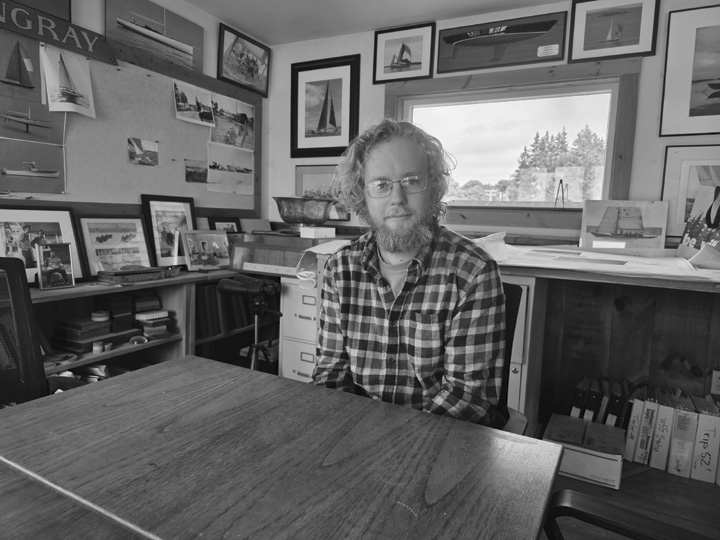
One of the most noted boatbuilders is Brooklin Boat Yard, which just began construction on a 47-foot powerboat designed by Will Sturdy. He explained, “This is a bit of a different boat for us. We don’t build a lot of power boats. We are primarily sailboat builders, although recently it has been more like 50/50. This boat is kind of my take on the whole concept of a Downeast express cruiser. The customer is a fun guy to work with and is super into the project. He wanted a boat that he could run offshore much more than he could with his existing boat, which is a 41-foot production boat. His idea of a fun weekend getaway is to knock off early from work on Friday down in New Jersey and steam up to Southwest Harbor, spend a night there and steam right back. So, he wanted a boat that could run fast, relatively speaking for a cruiser. We aren’t talking a 50-knot boat here but running in the 20s and do it comfortably in a pretty good sea condition. That was kind of our design brief and everything else was secondary to that.
“He likes the size of the 41-footer so we kept basically that rough interior volume and stretched it into a 47-foot hull,” said Will. “A little bit narrower on the beam overall, a lot narrower beam on the waterline. A really properly engineered light-weight boat, but still a good, rugged boat. We are using a lot of the tricks we have learned building performance sailboats to make it a really good lightweight stiff hull. We are weight conscious in the hull and deck structures of the boat, but those aren’t done in ultra-light fashion. The interior is more like the racing sailboats and how we are putting that together, so she really has a lightweight interior. The interior is a little different from most power boats just because she is long and skinny, but fairly conventional. What I like to tell customers is that the air is free, you don’t have to pay too much for the empty space. So, we have taken that to heart on this build. She has a nice stateroom up forward, spacious queen-sized centreline berth and a good amount of volume. There are a few lockers off to the sides and a good amount of standing room around the berth. It is not as compact as some. Then there is the primary head off to one side with separate shower and then just a head, no shower, on the other side. The galley is down. The owners aren’t into gourmet cooking on the boat, so she has got everything you need, but not much more. Then there is an interesting space off to starboard which is like a convertible seating area so it’s kind of a den, cozy nook to sit down and read, or an office. It can also be converted into an almost queen-sized bunk. Up in the wheelhouse, she has got twin helm seats off to starboard, a bench to port and then a U-shaped settee aft. We opted not to make this convertible. Then there are a couple of comfy chairs off to the other side. Out in the cockpit it is mostly wide open. We are going to put some seating back aft and then a little bit of cabinetry just for some deck storage.”
Under the cockpit there will be a generator and a Seakeeper gyro. “One of the driving factors of hitting the performance and sea keeping target is getting the weight and balance perfect,” explained Will. “So, rather than having the interior arrangement drive the weight and balance, we designed the hull, set the target. After running through all our design links to figure out exactly where the center of gravity ought to be, we designed the interior to fit around the center of gravity. Which is the way it should be, but unfortunately not the way it happens a lot of the time.
“She should be a good running boat,” continued Will. “It is single engine (MAN I6, 850-hp) and the propeller is tucked up in a tunnel. The shallower draft that the tunnel allows is a nice benefit. Primary reason for that is to just get a better shaft angle, better flow dynamics around the propeller.”
The hull is constructed with four layers of laminated plywood on the bottom, which is longitudinally framed. The topsides are like they build their sailboats, strip planked over frames with cold moulded veneers over that. The topsides are transversely framed so you get the classic looking wooden frames and planking, which will be visible on the inside. They are going to save weight by not having any ceiling plus it makes the boat look better.
“The goal is to get her in the water next spring,” said Will, “and hopefully get her up to a good cruise speed in the mid to upper 20s and topping out in the low 30s.”
This is not the only 47-footer they have building. They have just started building a 47-foot sailboat, which is a sister to the Eggemoggin 47+. Will said, “This will be hull #3 of that new and revised 47-foot daysailer. We have done a series of 47-foot daysailers over the years. It started off with the Bob Stephens designed 47-footer LENA, which was built in the early 2000s. That was a fun boat. Forty-seven feet is a nice size for a day sailer, because it is small enough that it is still easily handled, very lightweight boat, but it is large enough that you feel like you are sailing a real boat and you can have a bit of an interior down below. In 2012-13 a customer from Blue Hill hired Jim Taylor to make a few little changes to that design. Jim designed a new keel and rudder and then he, along with Eric Blake and Keith Dibble from here at the boatyard, designed a new rig. We also increased the free board a little bit and designed a whole new cockpit and deck layout. We built three of those boats, and those boats are kind of what gave the Eggemoggin 47s the performance reputation that they have got. A few years back, a customer was interested in buying one of those 47s, but he and the owner just never quite came to terms. He asked us about building a new one instead, so I sat down and started talking with him about how he was going to use the boat. A few weeks later we had the boat totally reworked and the only thing that stayed the same was the port side head. It was a totally new hull design, but it looked similar to the old one. The owner wanted it to aesthetically pass as one of the older Eggemoggin 47s.”
The real change came below the water, which has a totally different volume distribution, very different sectional shapes, and a very different righting moment curve. Will said, “That was a much more efficient hull, much more powerful hull. Still a long and skinny boat, but it is a foot and a half wider. Totally new foils. We worked with Dirk Cramers, SDK Engineering to design the foils. He is one of those America’s Cup foil gurus who knows his stuff when it comes to making foils go fast. We then designed a whole new rig, completely new deck layout that was much more performance oriented and that boat sailed remarkably well. She is 30 to 40 seconds a mile faster than the old 47s. These are a modern race boat that looks like an old daysailer. This is the third one of this version we have done, and it is for an owner of one of the other two.”
The design team also has been playing with other designs. They have several power boats, but the one that interests Will is the 38-foot express cruiser powered with an outboard. She will have enough of an interior for cruising. She will be light-weight and efficient with a cruising speed in the upper 20s or low 30s. There are also a 35-foot sportfish and a 38-foot traditional looking lobster boat. On the sailboat side they have an 80-foot cruiser and a 58-foot daysailer.
Will also works a bit on the side since they are so busy at the yard with their own projects it is hard for them to do work for other builders. The last boat launched by John’s Bay Boat in South Bristol in June, Will helped with the design. He added, “I’ve worked on a few projects with Pete (Kass) now and it’s absolutely fascinating working with him. I mean he has got the system for building a wooden lobster boat about as refined as you can. This one he had carved a half hull that met the preliminary requirements for the owner. He then hired me to work on the general arrangement of the boat, kind of refining what we could fit where, but more than anything providing a piece of paper that the owner could look at and see what he was actually going to get. I worked through that process with him and then worked through all the lofting. Pete doesn’t need construction drawings. He knows better than anyone else how it is going to go together.”
I asked if they ran it through a computer and did some fancy calculations. “There were a couple very small areas that we tweaked in the model,” said Will, “but I purposely try and not do too much. When I am working with guys like Pete, my philosophy is if it ain’t broke, don’t fix it. Pete’s made a lot of good boats and a lot of what makes them good are parameters that can’t readily be analyzed. Sure, you could do a whole CFD (computational fluid dynamics) analysis of the boat and I am sure you would be able to find some way to improve. Lobster boats aren’t the most efficient boat by any stretch. What a computer can do is it can help you optimize parameters like speed or more seakeeping. What makes a traditional Maine lobster boat such a good boat is that balance of efficiency across a wide range of different speeds. The rule of thumbs are still pretty darn good.”
Will grew up in the tidewater area of southeast Virginia. They did not live too close to the water, but he still managed to fool around in kayaks and some other small boats and loved it. He read everything he could about boats, but it was not until high school when he began sailing on some traditional large sailing craft. Then he got a job in a sail loft building sails. While there he started racing on some vintage keel boats, and that taught him a lot. He added, “I learned more about racing sailboats in a few years down there than I have in the “more competitive areas,” like around Newport. It was just a bunch of guys that were going out on shoestring budgets and just beating the snot out of those boats, they were getting every micron of speed that you could. Really good sailors.”
Will wanted to continue working at Evolution Sailmakers in Deltaville when he graduated from high school, but the owner, Jerry Latell, said that he would fire him if he did not go onto college. He added, “I made a deal with him and my parents that I would apply to Webb Institute (Glen Cove, NY) and if I got in there I would go, but if I didn’t, I wouldn’t go to school. Anyways, I got into Webb, and I did Webb for a year and it’s a wonderful school, but it just wasn’t for me.”
Webb Institute has their students do a winter internship and that is how Will learned about Brooklin Boat Yard. “I first came to Maine on a winter internship. Webb is a four-year program and every winter the school shuts down for about two months and all the students go on internships. The first year it’s all done in shipyards. Second year it is off on ships, primarily big commercial ships. Then the third and fourth years are in design or engineering offices. Webb is primarily focused on the commercial side of naval architecture and marine engineering, but I talked them into letting me come up here for that shipyard period.”
One of the square riggers Will had sailed on was the replica vessel DISCOVERY of the Jamestown Settlement, which was built by Rockport Marine. He talked with Sam Chamberlain there, but they did not have much going on that winter. He suggested that he call Brooklin Boat Yard. “I hadn’t even heard of Brooklin Boat Yard at that point,’ said Will. “The yard was just starting SONNY II at that time, so I came up here. That was January of 2013. When the internship ended, I went back to Webb and finished out the spring semester. I bought a boat in the fall, a wreck of a boat after Hurricane Sandy, rebuilt that over the spring and sailed it back up here and got a summer job and I have been here ever since.”
The first boat he was working on was building the 70-foot SONNY II, a cruising sailboat. This was followed by the Taylor 49 DREADNAUGHT. He did his best to stay on the floor building boats, but he said, “I got bumped up to the design office to help Keith Dibble with the drafting side. That was about when we started FOGGY. That was the first boat that I did all of the lofting and shop drawings, which was a bit of a trial by fire.”
He had learned a lot at Webb, but most of what he knows he got from reading books and periodicals. He read all the classic books on design and then he read the modern ones. Who did he look up to, well of course Herreshoff and other well-known designers. “A lot of the older historical boats I really appreciate, said, Will, “but they are all steppingstones. That’s not to say that a lot of those designers and builders weren’t far more brilliant than anybody else we have got today. What I appreciate about a lot of boats is how well they are fit for a purpose and that requires an owner who has a clear vision, a designer who is willing to honestly accept the owner’s vision and a builder who is willing to follow through on that. I think most of the designers I look up to are the ones you don’t hear a whole lot about. There are a lot of contemporary ones, for instance Jim Taylor whose been quite a mentor to me. It has been a real privilege to work with him on boats and then to also be able to call him up on boats that he has absolutely nothing to do with and pick his brain. He balances the factors. He takes what the owner needs and how the boat is constructed. There’s no fluff. You are not trying to make the boat look one way but build it a different way and then fix it with paint and trim work. I think different parts of the country had a lot of the same attitude that we still have in Maine over their working boats for years and years. I am not sure what the right term for it is, but it all got productionized. The way the fishery is in Maine there are so many different ways of fishing for lobster. Every fisherman has their own patch of water that has different requirements. They are running at different speeds. There is absolutely no way that someone could make a standard model and have it appeal to more than 15% of the fishermen. Fishing boats just have a way of developing from economic factors, always driving down to what is the purest way to meet a need. Often times, there is no named designer for any of those boats. Those I think are the boats that inspire me the most.”
What about being in Brooklin? He said, “Once I got here, it was like, how does the whole world not know about this place? This is like the mecca of wooden boatbuilding and smashing traditional and modern construction together in ways that no one else is doing. Just being able to sit down and talk with a lot of these original sources. There is a well-known book written about the boat yard, “Unit of Water, a Unit of Time,” which is a great book, and I read that before I came up here. I came just at the right time, because probably about half of the guys in that book were still working at the yard when I started here. Within five years there were only three or four left. To the first guys it was just a boatyard, that is what you did. If you wanted to build a boat, you came to a yard like this. The second generation I think kind of knew that it was something special.”
For those looking for an education in the boating world, Brooklin has to be one of the best places to get it. It is no wonder the town and the boating companies there attract people like Will Sturdy to come and live their life there. It is a special place with so much to offer and those in the know go there to soak in all the can.