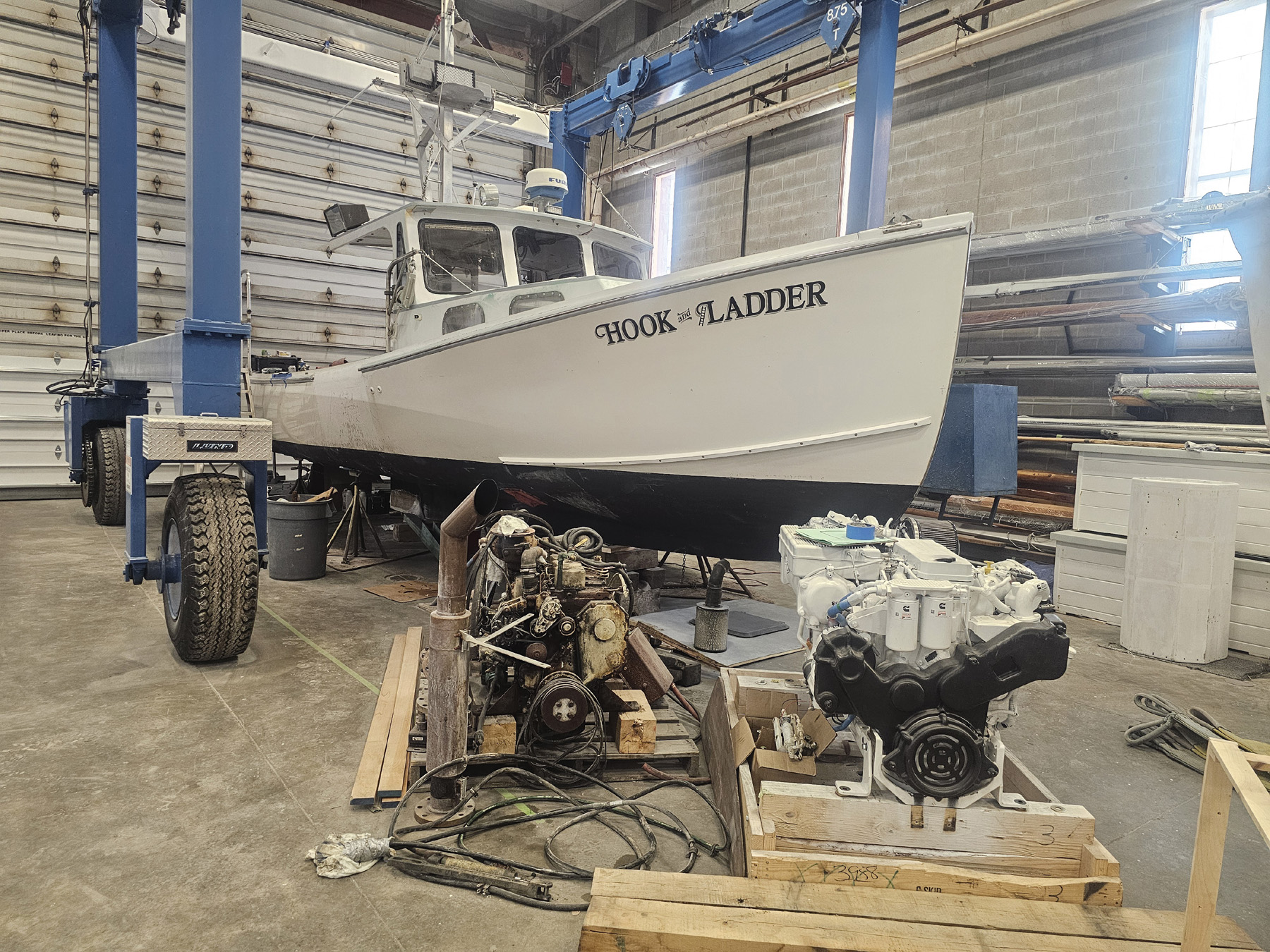
This Holland 30 is getting repowered and upgraded by three students at Maine Maritime Academy in Castine. In the foreground is the original 210 being replaced by a 485-hp Cummins.
CASTINE – There are always interesting things going on at Maine Maritime Academy in Castine. One project that captured my attention was the repowering of a Holland 30 by Alden Sawyer, Devin Grant, and Griffin Stolp, which is scheduled to make an appearance at this year’s lobster boat races.
Heading the project is Alden, who added, “I didn’t want to do something like all the other seniors in the five-year marine systems have done for their Capstone project. Capstone is a project that you do that kind of encompasses everything that you’ve learned throughout your time here. Sometimes it gives back to the community, and some people do things like testing windmills for UMaine power generation. That really wasn’t that interesting to me, I wanted to repower a lobster boat and race it in lobster boat races.”
Alden then got Devin and Griffin involved. Devin said they were friends and when Alden asked for help, he was on board. Griffin said, “I think we all just kind of got looped in. It’s a cool project. There are just so many facets to it. Just an all-around super cool thing to be working on.”
The first thing Alden needed to do was come up with a lobster boat. He started by searching the internet and asking around. He looked at a number of boats, took a ride on the South Shore 30 LADY J, but really wanted the 1979 Holland 30 HOOK & LADDER from Chebeague Island. He contacted her owner and made a deal mid-fall. Alden said, “She was pretty solid. Everything worked. She had a 210-hp Cummins with 7,000 hours. She had a keel cooler, and I think the keel cooler needed to be cleaned out because it would overheat at high RPM. We steamed her up December 2, the day after my birthday. We all stayed down in Falmouth and left at like 4 o’clock that morning out of Royal River Boat Yard.”
They were also joined by another classmate, who was a deckie. Her flight had been canceled and she had to fly into Portland and asked for a ride with them, not at first knowing she was going by boat. “I don’t think she really knew that we planned on a nine-hour boat ride up to school,” added Alden.
This was the only day they had free and the weather looked like it was going to get worse as a nor’easter would be moving in. However, when they got up by Pemaquid Point the weather was not good. They had a couple of good-sized waves crash over the stern onto the platform. Griffin added that some went right over the top of the cabin. Fortunately, when they got into the protection of the Mussel Ridge Channel the seas calmed down and the rest of the run was good.
When they arrived in Castine they put her on the dock at Eaton’s Boat Yard. Alden had helped out at the yard here and there and the following day they put her on the dock at the Academy. She then got hauled out and placed at Eaton’s Boat Yard on the hard.
Since the Academy does not allow boats other than theirs to be placed in the waterfront building, they had to make their case so she could go into the work bay. Alden said, “It was like a four-page paper with this is who we are, this is what we want to do, and this is why it will benefit the school. It was a lot of convincing that we had to do in order to get permission to put the boat in the bay. Once we finally got permission, the next day a hydraulic trailer came in to move some of the school’s boats and we had him pull our boat over. We then picked it up with a travelift and put it in the bay.”
It was now the beginning of the spring semester in January, and they had just finished their Coast Guard exams. Devin said, “The first thing we did was disconnect everything from the old motor, getting it ready to pull out.”
Griffin added, “Figuring out where we were going to make the cut to get the engine out too. We consulted a lot with Terry down here at the waterfront and some of the other guys that are knowledgeable about all the fiberglass stuff.”
They finally figured going out the cabin top would be less cutting and less glassing. With the engine out they knew they had an issue with her skeg. Alden explained, “When I bought the boat, I noticed it was bad and I asked the owner what is the deal with the skeg? He said that he bought it like that and it’s been fine.”
The skeg was made with oak and lag bolted and glassed to the hull. A potential problem is that oak has acid in it and that will not allow fiberglass to stick well to it. Getting the lag bolts out was a challenge even though the wood was rotted. Then they replaced the skeg with the assistance of Matt Sledge from Samoset Boat Works in Boothbay.
The next biggest question was what to do for an engine? Alden said, “We were planning on going with a 6.7 liter 425-hp Cummins with the original gear. We were going to reuse the shaft, but when we ran shaft calculations the safety factor was not ideal. Then Dominic at Freeport Diesel said that he had an engine. He texted me on Wednesday, I called him and that Saturday I had the engine in my truck and back up at school.”
The engine was a 2022 480-hp Cummins with no hours, which had been pulled out of a boat that was never run. The problem was that the gear was a 1.214:1 ZF and that was not the right ratio they needed if they wanted to swing the right propeller. So, the search began for a 1.5:1. Alden called around and in the end Greg Sanford at Billings came up with a gear that would work. Now it was getting everything in and hooked up. The new two-inch shaft came from Billings Diesel & Marine and that meant the rudder shaft also needed to be 2-inch. They also replaced the fiberglass rudder with a stainless steel one. This they made right in the welding department from designs they had created.
The steering and hydraulic pump were belt driven off the front of the old engine. Alden stated that they thought they could run a PTO (power take-off) stack off the new engine and that would give them more room in the cabin.
They also needed to replace the steering system, which was not a big job.
Griffin added, “We are moving the thru hulls back for the water pickup. The calculations that we have done up at ABS shows the bow coming out more so if we left the thru hulls where they were at for the raw water cooling, we would just be sucking air at full speed.”
An interesting aspect of this project was the work they did with the design of the boat. They had lots and lots of information, but figuring out what it all meant was challenging. They developed a speed power curve, where you can see the hull pressures. They put spray rails on the boat, just to see how spray rails worked, and Devin said it did not really affect the boat, which surprised them.
Several years ago, Doug Reed of the Academy, also the advisor on this project, was trying to come up with an alternative tri-hull lobster boat and the boat they put up against it was the Holland 38. The Holland 38 actually performed extremely well against the tri-hull showing just how efficient the Holland hull is.
They are now in the final stages and just in time as they need to be out of the bay in mid-March. Fortunately, the boat the Academy has in the bay will not be ready till the end of the March giving them some leeway.
“None of us really knew what we’re doing,” said Alden. “Every step of the way we are learning, figuring it out and making it work. I’m really glad that we chose to do this project, because I am learning so much more than if I did any other project.”
Griffin added, “We can do all of this math and naval architecture-style stuff with the professors and then we have got all the salty Mainers who just come in and give us advice and throw parts at us when we need it.”
When finished they are hoping to make the lobster boat races but are not quite sure which ones since everyone in the team has to do a co-op during the summer.
Alden has been coming to the lobster boat races since he was very young. He said, “We would go on my mother’s 19-foot Eastern TEA CUP. We would watch the races, and I got wicked interested in it. When I was older, I would go out with my friends to the races. We would all raft up and do the whole ordeal. My mother bought her boat (WILBUR, a Holland 32) probably five years ago and she likes to race it at Harpswell, Long Island and Portland.”
All are trying to find a local co-op so they are around and can do some of the races so let us hope they can make at least a few.