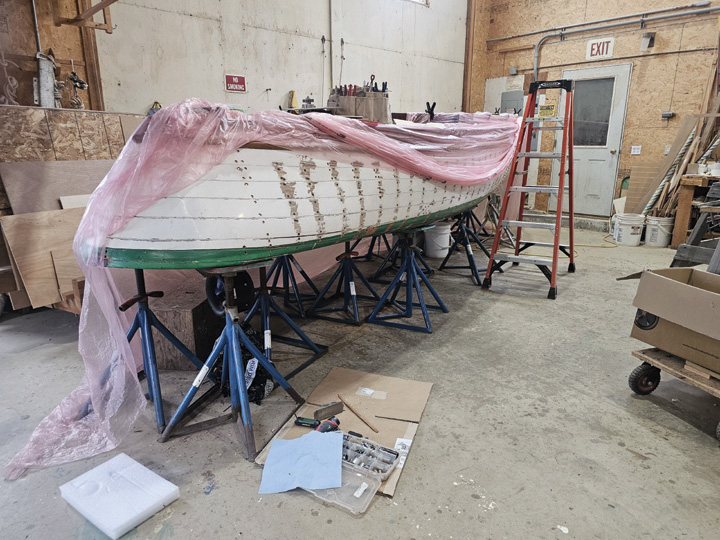
A Fay & Bowen launch from 1906 being rebuilt at Hylan & Brown in Brooklin. They have replaced frames and part of her keel and added an electric pod.
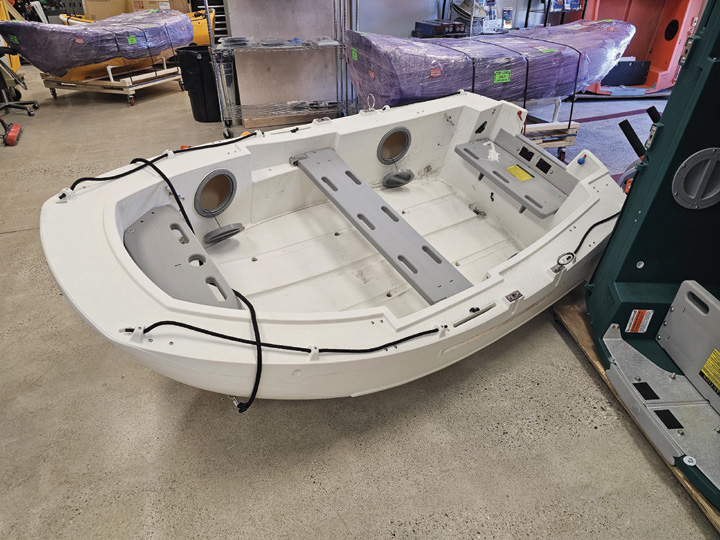
This is a Portland Pudgy, which is 7 feet 6 inches in length and can be rowed, sailed or powered with an outboard. They are built in Biddeford.
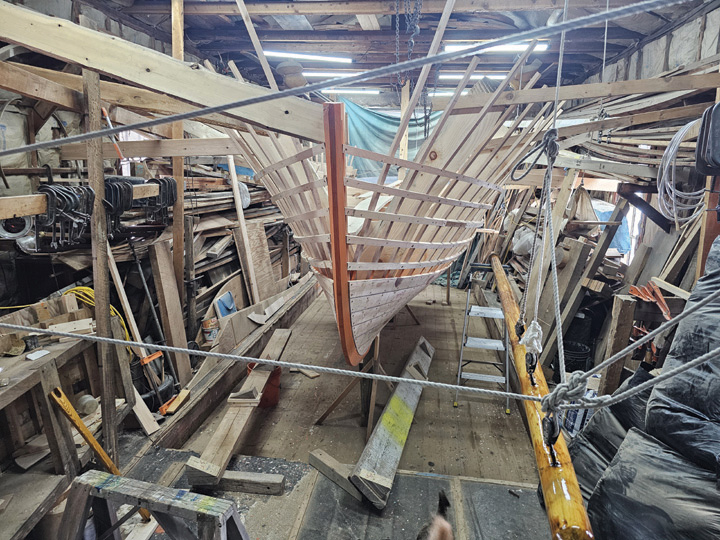
This is a 21-foot Striper, under construction at Riverside Boat in Newcastle. She is halfway planked, but she is on hold while yard workers get the storage boats ready for the water.
Hylan & Brown, Brooklin, ME
One never knows what they will find in any of the boat shops up and down the Maine Coast. When I walked into the main shop there to the left was a 1906 Fay & Bowen torpedo stern launch. This company was started by Walter Fay and Earnest Bowen in Geneva, New York as the Fay & Bowen Engine Co. in 1904. Over the next 25 years they built approximately 900 boats before the stock market crash of 1929 forced them to close their doors. This one was found in upstate New York and was mostly original. The big problem was that someone was recutting all the seams with a skill saw, but had set the saw depth too deep and cut halfway into every frame. So, every frame needed to be replaced and riveted. While working on the frames they also discovered that they needed to replace a portion of her keel before they could add an electric pod drive. With this drive system they needed to stiffen the area around it. This boat will be used as a harbor launch in Buck’s Harbor and that means they will also be adding additional seating.
I am coming away with more questions about the development of the torpedo stern as to where did it originate? When they were working on the stern framing they thought that they would find a chine log. Instead, they found a bunch of steam bent frames with a very hard turn and all were broken. Ellery Brown added “These guys basically did the same model with two different sterns. They had sort of a fantail and then they had the torpedo. I don’t know how many of each they did and I also don’t know how many of these there are around, but there are a few.
Then behind the Fay & Bowen launch is the wooden 50-foot Elco cabin cruiser PATIENCE, which is in for a total restoration. This restoration began at Paul Rollin’s shop in York years ago and then came here to be finished. This has been a multi-year process. The last time she was in the shop she received new fore and main decks, which was several years ago. She was brought in again this year and they worked on her interior. They put in the ceiling, bulkheads, forward cabin and fo’c’s’le. They also got work done on the trunk cabin and main pilothouse. With time running out they feel like one more winter might be enough to complete the project. Ellery said, “The last one will be mostly just engine and interior work. She is starting to look like the whole package. The pilothouse was traditional raised panel mahogany, but we did it nontraditional, plywood cored with Sepo ¼ to 3/8-inch veneer. It will look 100 percent traditional but it was all vacuum bagged so it is going to be much more stable and maintainable than floating raised panel construction.”
One concern is that before she comes in for the last phase they think they want to put her in the water and get her to swell up since she has been out of water for a long time.
Another interesting aspect of this boat is that there were several different versions of this 50-foot model. However, the owners have done a lot of research and know this one was from 1926 because the wind screen was vertical and the pilothouse was almost out to the gunnels. Ellery thought that there were at least five or six of this size Elcos still in existence and all well-maintained.
In the shop off to the side is the William Hand designed WOMBAT, which is cold-moulded and was built in South Freeport in the 1990s. This boat was originally fitted with an inboard gasoline engine, but several years ago was switched over to electric power. This motor was not performing as the owner wanted and they are switching her over to a new E-Propulsion 40 kW motor. The previous motor was under the cockpit sole and the new motor will be further forward, meaning new motor beds and shaft. The two lithium batteries are rather large, each weighing 400 pounds, and these will be fitted under the side seats. Ellery added, “This owner is very knowledgeable. He actually started the conversation with us about converting it to an outboard and wanted to put a motor well in the back. We started talking about what don’t you like about her electric system? We told him, ‘I think if you stuck with electric we could do a lot better than what you have.’ He ended up going for that. His wasn’t that old and E-tech is a viable motor, but it has been kind of messed with. He also had some sketchy lithium-ion batteries in it. All this is from E-Propulsion is absolutely the latest.”
Next to WOMBAT is a Glen-L designed runabout. The owner was interested in a new electric runabout, but did not like the quote they gave him. The owner then asked if there was anything they could adapt to what he was looking for and they found this boat with a big gasoline engine. Due to the amount of weight previously they needed to distribute the weight since she is getting an electric outboard mounted on a bracket with one battery under the foredeck and the other in the stern. Once completed she will be heading to her owner in Minnesota.
Ellery also said that he had just come back from an electric boat demonstration at the Fishermen’s Co-op in Spruce Head. The Island Institute had set them up with an electric workboat. Fogg Boatworks of North Yarmouth had built a flat-bottom aluminum workboat, powered with an E-Propulsion outboard, for carrying crates around the harbor. For the demonstration they towed a string of crates, and due to an electric motor’s torque they had no problem. Since the boat is not in constant use it could be plugged in when tied to the dock. They did feel that they could work the boat three to four hours before she needed to be charged.
Lyman-Morse, Thomaston, ME
Lyman-Morse has begun construction of a new 15,000-square-foot facility to support large-scale composite fabrication and assembly, marking a significant expansion of the company’s manufacturing facilities in Thomaston, Maine. The new building will be the third facility on the campus and will hold the company’s Advanced Composites Center. It joins the Lyman-Morse Workboats division, and Lyman-Morse Technologies building, which houses the company’s CNC and metal additive department.
Together, these three facilities position Lyman-Morse as a fully integrated advanced manufacturing partner capable of delivering across multiple materials and disciplines. This combination allows Lyman-Morse to support a wide range of applications, from marine systems and vessels to industrial components and specialized engineered solutions.
With the addition of the Advanced Composites Center, Lyman-Morse continues to broaden its capabilities across: Rapid Prototyping; Composite fabrication and structural components; Metal additive manufacturing – 3D printing SS316L; and Custom-engineered systems and assemblies.
Purpose-built to support the company’s advanced composites capabilities, the new clear-span building includes a radiant-floor heat system to provide consistent climate control for construction projects and teams. Integrated compressed air lines, vacuum pumps, and IT infrastructure support the modern tools and equipment used in composite manufacturing, and two 5-ton overhead cranes will enable efficient movement of large structures throughout the building. A planned renewable energy system will enhance Lyman-Morse’s commitment to sustainability and environmental responsibility. The interior layout is engineered for flexibility, allowing teams to manage complex manufacturing projects while maintaining precision and efficiency across all stages of production. The new building represents a major step forward in Lyman-Morse’s scale, efficiency, and technical capacity as demand increases across the marine, industrial, defense, and specialized fabrication sectors.
“This expansion is about giving our team the space and infrastructure they need to execute at the highest level,” said Samir Gupta, manager of Lyman-Morse’s Advanced Manufacturing division. “This new building allows us to take on larger, more complex projects with greater efficiency.”
The project is supported by an award from the Maine Technology Institute’s Maine Technology Asset Fund (MTAF3.0), a state program that aims to boost economic activity and grow the state’s innovation economy. When completed in summer 2026, the ITAR-compliant Lyman-Morse Advanced Composites Center will join Lyman-Morse’s two other specialized manufacturing facilities on Elltee Circle and create a fully integrated, world-class hub for innovation in advanced manufacturing, metal and composite fabrication, and technology development.
The two other Lyman-Morse facilities on Elltee Circle that comprise the Advanced Manufacturing Campus include:
Precision CNC machining operations, utilizing 3- and 5-axis machines; EOS M290 metal additive manufacturing system; Workforce training and development; ITAR compliant and ISO9001:2015 certified.
Construction of aluminum workboats, landing crafts, and emergency response vessels; Specialized production of commercial and government vessels; Aluminum, Stainless and Carbon Steel fabrication with full finish coatings; Standards: ABYC, ASME IX, AWS, ABS, AISC, NAVSEA, DEP; In-house AWS certified welding inspectors (CWI) and certified welding educator (CWE); AWS D1.2 certified team of welders in marine specific alloys – 5086/83, 6061, 5052; and ISO9001:2015 certified.
By bringing together composites, metals, and additive manufacturing within a single campus, the Lyman-Morse Advanced Manufacturing Center is positioned to support increasingly complex projects while maintaining the craftsmanship and problem-solving approach that has defined the company for nearly half a century. The expansion reflects Lyman-Morse’s ongoing investment in advanced manufacturing infrastructure, workforce development, and domestic production capabilities.
“This project is about building capability for the long-term,” said Drew Lyman, president of Lyman-Morse. “We’re creating a facility that not only supports our current work but positions us for the next generation of manufacturing challenges.”
Padebco Custom Boats, Round Pond, ME
They have been busy this winter with their usual storage boats being moved in and out of the work bays in the main workshop. One of the big projects is on a Padebco 27, which is in for a second year. She was powered with twin 150-hp outboards. These have been removed and they enclosed the transom so they could add a full width seat. They also added some stern facing seats. They have removed the soft top and will be replacing that with a hardtop, which is almost completed. The outboards will be replaced with twin 200 outboards on a bracket and these will be controlled with an Optimus 360 joystick with electric power-steering. Leon McCorkle added that he was heading to Florida to get a refresher course in their installation. This project will likely be done early summer.
They also have been building a new Padebco 23 centre console, which should be completed in June for a customer from Biddeford Pool. She will be powered with a 150-hp Yamaha outboard.
Their boat brokerage has sold a couple of boats this winter. One was a 20-foot Grady White. Leon was thinking of putting one of his boats, a 23-foot Parker, which is getting repowered and new canvas, on the market. He thought, and figured other yards were feeling the same, that customers were not spending like they have in the past few years.
One other thing was that with the change in the administration, the loan that was awarded them due to the storms two years ago, had dried up and disappeared. They did receive funds from the state that was used for engineering and permits to lift a building on the waterfront, build a substantial foundation under it and make repairs to the ramp. They do not have the funds to complete the project, but they have the ground work done. They were thinking of maybe doing some of the project in house, but were not sure if they could do it in phases.
On a side note, Leon has been involved with Lincoln Academy, assisting with boatbuilding and maintenance courses. He said, “We have got an ABYC, which is actually up and running. I taught the first trimester last year and then this year one of their instructors taught it. They are not taking the test at the end of the year and getting certified yet, but they are getting there. There is a lot of interest in the class. So, it is going well.
“Those kids are getting a broad overview of what we do,” explained Leon. “They are getting some work on inboard diesel, outboards, I/Os, drivetrain, a little bit of transmission, how lights are wired, seacocks, plumbing systems and things like that. If you took the system certification, the electrical certification and then added engine, and maybe even the ABYC gas and inboards, that is what they are teaching at the high school level. I want to see it expanded to an all-year program. Definitely we have to beef up that curriculum a bit to make that happen, but it is doable. I’m probably going to go back next year and teach.”
Portland Pudgy, Biddeford
For those that head down Route 1 south of Biddeford proper, you will see on the left side a building with a couple of small dinghies out on the lawn. This is Portland Pudgy, a great 7-foot 6-inch recreational dinghy produced in several colours.
They build this boat with a roto-mould using polyethylene, which makes them almost indestructible. They can be used in a wide variety of situations. It can be rowed, sailed or motored. A number of long-distance cruisers love them as they are seaworthy and do not take up much deck space. The designer was a pretty avid sailor and saw the need for a lifeboat dinghy combination that had this kind of durability to it.
They are looking at options for different sizes, maybe even a different hull design.
If they work well on the Maine coast, which is covered with numerous jagged rocks, they will work well pretty much anywhere. They like to say it’s like the compact car market. A lot of people like big trucks and a lot of people like compact cars and that’s our market.
Riverside Boat, Newcastle, ME
There are several yards on the coast of Maine that will take you back in time. This yard still uses a railway and nearly all their 70 boats are wooden with the exception of just five.
The winters are always busy. This winter they brought in a Valentine, design by Creston Bryant, which is a 15-foot sailboat. She has a carvel planked bottom and lapstrake topsides. She received a new stem, new forefoot, and chine ends. The bottom strake on the topsides was replaced halfway back and all new bottom planking. Then she was given a paint job.
There is a 22-foot launch in another shed that has received a new stem, new stem knee, new forward end of the keel and now is getting planked back up.
The Concordia yawl outside has some issues and before going over they will replace a couple of planks and then recaulked.
There is a 22-foot launch in need of a couple of new garboards and a Rhodes 36 needs one plank before she can be launched.
The 21-foot Striper got its moulds, ribbons and frames put together this winter and is about halfway plank up. She has an owner, but he will not see her launched this year.
Other work included a flagpole for one of their dock customers and a runway for another.
Southern Maine Marine Service, Arundel
If you have been travelling Route 1 south of Biddeford you should have noticed a major construction project underway here.
In August last year, the owner of Kennebunkport Marina purchased this company. They explained, “We outgrew our spot in Biddeford and we were looking at another piece of land in Kennebunk for boat storage. Before we pulled the trigger on that, I talked to the owner here and just said, “We are getting ready to do another project. We talked about this the last time we did a project, and you weren’t ready to sell. Before I pull the trigger on this other property, do you have any interest?’ At first it was a no, and then a week later a maybe and then it was yes. We talked about numbers and timelines and came up with something that worked for both of us. This gave us the room to grow and it will let us bring our service business here and a lot of our storage business. Right now, we are just finishing up a new shop and then we will have a storage unit going up.”
The new shop was started last November and is 6,000-square feet with a mezzanine break room for the employees. This will likely be finished mid-May.
The front of the main building will remain a showroom. In the rear was a work bay and this will be used for parts and offices.
This property had been sub-divided and now it is back to one lot. They will be building a 30,000-square foot heated storage building. They have been blasting rock and as soon as the ground work is completed they will pour the concrete for the building. This will be a big addition to the two 12,000 square-foot cold storage buildings. One of these has already been turned into heated storage with plans to convert the other soon.
They are a Mercury dealer and are full-service dealers for Yamaha and Suzuki. They do not have a boat line, but this may change in the near-future. Their Wells store is a Suzuki dealership down at Webhannet River Boat Yard.
They are looking to service the area boaters between the Saco River and Wells better and making these changes certainly shows their commitment.
Yankee Marina, Yarmouth
There has been a lot going on here this winter. One of the major projects was on a Crowley Beal 36, formerly a lobster boat, which they put an interior in. They had to do a lot of ripping apart to make sure everything was still bonded to the hull. The first year they replaced the balsa core decks, which were totally gone. Last year they cut the hard top back and painted her.
For other projects: an Ericsson 35 was in to have her electrical system upgraded; a Defever 49 was in for extensive shaft work, which included pulling the stuffing boxes, milling them down, installing Tide Marine seals and then aligning the shaft; a 53-foot Stevens sailboat had her air conditioning and Victron battery monitoring system replaced; a Maine Cat was in to remove her electric drive system and installed Yamaha outboards; and a full restoration on a Aquasport 26.
The paint bay has been busy all winter. They have painted a Grady White, Aquaport, Mako, High Seas, Hinterhoeller, J-boat and a Hunt cold moulded powerboat.
In one of their main bays they have the motor yacht IROQUOIS, which they are assisting with. This project is being run by Richard Stanley and is progressing well.