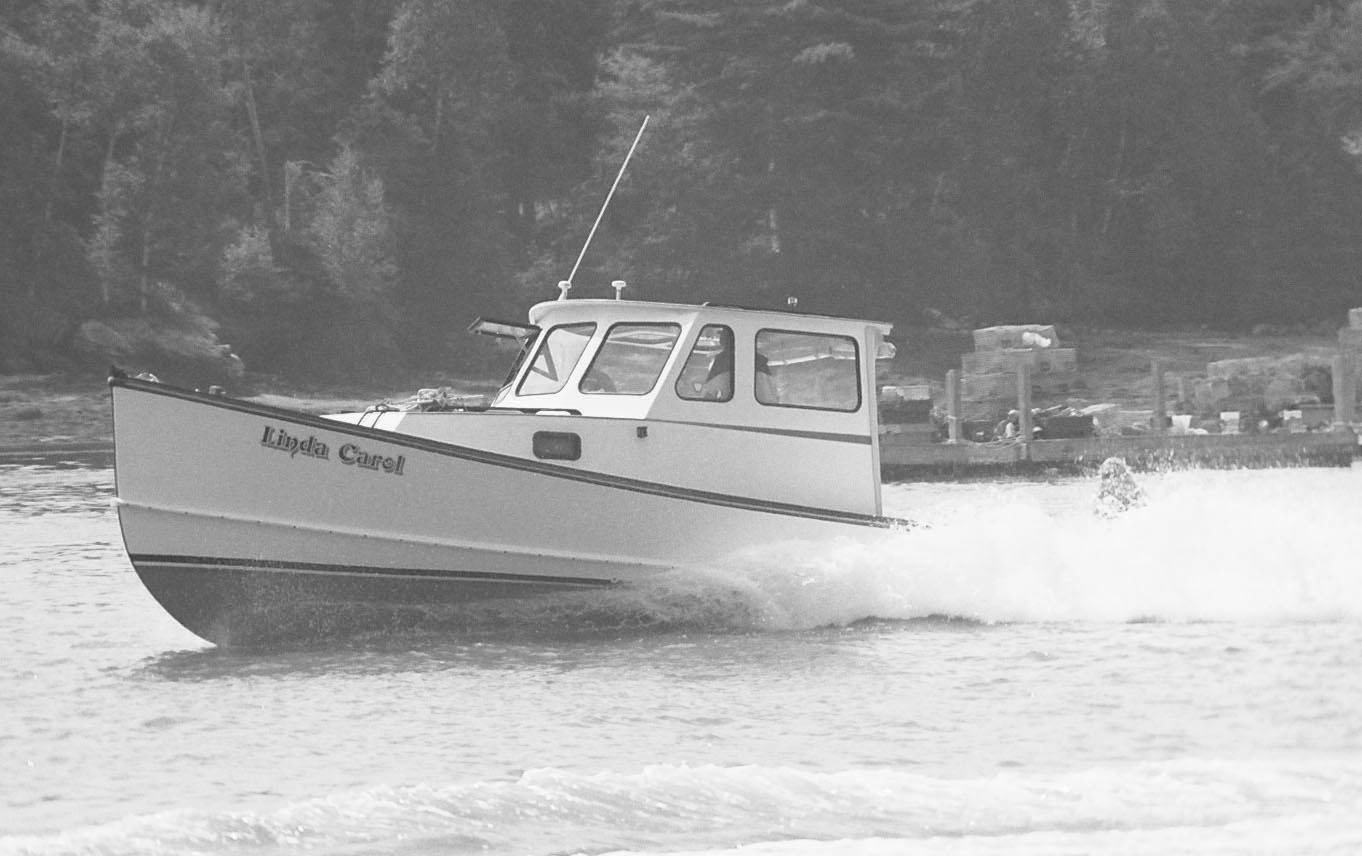
Chris Smith’s Repco 30 LINDA CAROL competing in the lobster boat races in 2010.
JONESPORT – Over the years there has been numerous fiberglass lobster boat builders starting as far back as the 1950s. Some of these developed some great models that have lasted the test of time. One of the best known, and there are still a number of them fishing up and down the Maine coast, is the Repco. Fortunately, I was able to sit down with Chris Smith of Richmond and talk about this company before their history disappears forever.
Chris was born in 1960 and when he was seven Repco opened their doors. Chris did not grow up in Gouldsboro, the home of Repco, he was living in Jay. He explained, “My mother’s brother, Harold Lathrop and her brother-in-law was married to my mom’s sister, Vern and Virginia, who all lived in Gouldsboro. My uncle Harold had built wooden boats for about 12 years. He worked for Harv Church for a number of years, and he put up a small shop of his own on the Gouldsboro Point Road where he could build one boat a winter. He would build a boat and fish it during the summer as a new boat. He then would pull it out in the fall and put it up for sale. Then he would build another one that winter. There was a lot of Harv’s influence in his boats, especially in the 30.
“My uncle had made some changes,” added Chris. “He built seven as 27-footers and then he stretched one to 30 one winter and he liked it a lot better. He said it was a better boat and so that is what the 30-foot mould was taken off of. People used to call them the canoe, especially the 30 because they are only like 6-feet wide at the stern. Even though there was a lot of Harv’s influence, it was technically my uncle’s design. The 21-foot hull came from a friend of theirs who actually was a carpenter at the boatyard for years and years, Ollie Leighton. That was his design. He had built that boat out of wood when he was still living in Massachusetts and he brought it up here with him when he moved.”
Ollie came from Pigeon Cove in Rockport, Massachusetts where he started building wooden boats. Chris said, “I have seen pictures of the wood boat that he built for his son, who was Ollie, Jr. down in Massachusetts. He worked in my uncle’s shop for 15 years. Pretty much my whole recollection of them being on Route One, Ollie was there.”
Chris did not remember much about Harv Church. He said he remembers seeing him in several photographs and in some newspaper articles and ads.
The shop on Route 1, “That came to be I believe in 1968,” said Chris, “because they had my uncle’s small boat shop and they had to move the mould outside and flip it upside down before they could finish the hull. There was no room in there. They built the mould in my uncle’s old shop and laid the first hull up and I remember being down there for the unveiling of that and there were cars lined up on the Gouldsboro Road as far as you could see, both sides of the road, because it was new.”
Chris added, “They had gone over and worked some with Cy Cousins at Webber’s Cove he was laying up Navy launches at the time. My uncle Harold and my uncle Vern both had machinist backgrounds, as do I. They were very keen at watching how somebody did something and being able to duplicate it with their own hands. The piece of land on Route 1 was in my uncle Harold’s wife’s family, so they got the piece of land relatively cheaply and I believe the loan for the building was $60,000. They paid that off in about a year and a half.”
Once the shop was up on Route 1, they introduced the 37. Chris said, “Ernest Brierly and I have the original line drawings for the 30 and the 37. They wanted a set of line drawings because they knew the 37 could be Coast Guard certified but you needed a set of lines to give to the Coast Guard. That was pretty much a collaboration of my uncle Harold, uncle Vern, and Dick Snyder their other partner who was my uncle Harold’s brother-in-law. It was mainly a collaboration of the four of them. They all kind of put their ideas together and that was the hull that they came up with. Ernest Brierly did the line drawings, and they had him do the 30 at the same time. I remember Dick Snyder said this is stupid, we are never going to need those line drawings. These guys were as frugal as frugal could be. When they closed the doors in 1987, they were drawing a $9.00 an hour paycheck. They did have a very good profit-sharing plan at the end of the year. They were in business for 20 years, basically from ’67 to ’87 and really only had one winter where orders were slow, the rest of the time they were pretty much flat out. Hulls being the main business. My uncle Harold used to say you double your money on a hull, between labor and materials and the wear and tear on the mould. And he says finishing boats that just gives a customer something to see when he walks through the door.”
Chris mentioned Franklin Beal of Milbridge, who he said was an excellent wooden boatbuilder. His son Jimmy was also a good wooden boatbuilder. Then came fiberglass and they knew how to build the deck and house, but as far as the running gear that was all new to them. Franklin worked for Repco for two or three winters and Jimmy a couple of winters. Jim Smith also worked in the shop, but then he left and built his own shop on the Leighton Point Road in Milbridge and finished off hulls. He would finish off a Repco 30 in 1990 that Chris came to own named LINDA CAROL in 2004. She was built for Ollie after Passamaquoddy in Eastport had bought the moulds. This is thought to be the last one taken out of that mould. Ollie sold it to Chris, but she was in need of some work. Chris said, “I didn’t know enough about fiberglass at the time to tackle it myself, but Jim Smith remembered me from when I was a kid. I went and I saw him and told him what I was thinking about doing and said, ‘I am going to need some help.’ He said, ‘You do the mechanical and the wiring and he says, ‘I will do the building and before it is over with, I will teach you how to do fiberglass work.” Linda and I traveled every weekend from Richmond down here. My aunt Ginny was here for the summer staying at the Red Barn and we stayed with her until she went back to Alabama and then we stayed at Jim and Joanne’s house every weekend until it was done.”
Another name associated with Repco was Abiel Briggs. Petite Manan Boats, Kevin Briggs, is his son.
Chris said, “A lot of really good wooden boatbuilder worked a winter or two for them. I can remember one winter in the early 70s Franklin and Jimmy were building a 30-footer, Jim Smith was building one next to it. Abiel was building one, because they could get four 30s across the front of the shop.”
We went back to the early days, and Repco was being run by Chris’ uncle Harold, uncle Vern, and Richard Snyder. “When uncle Harold built wooden boats his brother-in-law Richard was a partner in the business. He was my uncle Harold’s wife, Alice, Richard was her brother. When Harold was building wooden boats in his little shop Richard helped him every winter. Richard was a fair hand. He knew his way around a wooden boat fairly well. My mother’s family came from Oakland. My uncle Harold worked in Connecticut for a while at Hamilton (machine parts company for defense contractors operating in East Hartford) as a machinist. I never really knew how he ended up back Downeast in Gouldsboro fishing and building boats. I don’t have a good answer for that. I can remember my aunt Ginny and uncle Vern still living in East Hartford because my uncle Vern was a supervisor for Hamilton and made good money and walked away from it all to go to Gouldsboro and live in an A-frame and build boats. My uncle Vern came from East Hartford, but he was originally from Maine. He ended up in East Hartford because of the job, and he and my aunt lived down there probably 8 or 9 years. They were all in their late 30s, early 40s when they started the boat company.
“My uncle Harold found a piece of land down on Gouldsboro Bay,” continued Chris. “It wasn’t deep water frontage, but it would work for a wharf lot and there was enough land there to build a camp. He really didn’t have the money to buy it, but he had connections to buy it, so he bought it. My uncle Vern provided the financing, and he bought the piece of land, I think at the time, it was $4,000 or something, back in 1964. He and my aunt and family members all helped put up a small A-frame. It was a camp, that is what they built it for, and you know fast forward two years, and they were living in it and making the best of it and building boats.”
“Over the years all three of the owners ended up with a 30-foot boat,” said Chris. “They didn’t know how busy they were going to be so the plan was that Harold and Richard would fish in the summer, and my uncle Vern built a big float, and he was going to buy lobster in Gouldsboro Bay. There was only one wharf you can get to at low tide. So, there was no place for the guys to sell, they were going to Corea. They set up that buying station out in front of my aunt and uncle’s place, on a mooring. My uncle Vern bought lobsters for one year, by the time the second spring rolled around they had orders out two years. So, there was no fishing for Harold and Dick, which I don’t think they were happy about. Then they had to hire a crew and needed to pay attention to business, and my aunt Ginny took over the lobster buying business. My aunt Ginny at 40 was a very attractive woman and trust me all the fishermen, they loved coming in to sell lobsters to Ginny. She did it for probably four or five years. There was another buying station by then up the bay, and they had gasoline because all the boats were gas then. They also had bait. My uncle put in a 500-gallon gas tank down by their wharf, just for their own boats and the next thing you know, my aunt Ginny is sacking 5-gallon cans in the skiff at low tide out to the float. She put her foot down at bait, saying ‘I am not doing bait.’ This is 60s-early 70s and back then the lobster catch in Gouldsboro Bay was nowhere near what it has been in recent years.”
Chris loved going to Gouldsboro to be with his uncles and aunts. He would go down on school vacations and holidays, not always, but most of the time. He did not fish because back then you needed a helper’s license to be a sternman. When he went fishing, he would go below next to the 455 Olds engine and fill bait bags where the wardens could not see him. When his uncle Harold figured out that he was interested in building boats he would not tell Chris anything saying that he did not want any part of this business.
Harold would pass away around 2000, and Vern would die within two weeks of that. Richard had already gone by then.
Over the 20 years Chris thinks that they built over 500 boats from the three moulds. He said that every May they would lay up six or eight 21-foot hulls and sell them that winter. The last 37 Chris thought was #137. Chris added, “When they replaced the first 30 mould, they deepened the keel 6-inches, and they put some convex in the stern. In the original model the stern was plumb. The first model you could get an 18-inch wheel under it and the second one you could get a 20-inch wheel. A 292 ran an 18 x 16, a 350 Chevy ran a 17 and a 454 you ran an 18 x 18. With those gas engines there was not enough torque to really do much with. When diesel came in, they put a lot of Isuzus in the 30s in the later years. Back then there wasn’t a lot of choices, especially in small diesels. They did put some 353 Detroits in a few of the 30s. The popular engine for the 37 was the 3208 Caterpillar.
The last Chris knew you could still get a 21 hull through Tri-Town Marine in Harrington. He said, “I don’t know if he had the mould or if he knew somebody that had it. The 30-foot mould and the 37 mould the last I knew they were tipped upside down in a parking lot down in Eastport.”
This might have been in the 1990s as Gary Kief had the 37 for a time and made some modifications to it when he had a shop in Lamoine. However other hulls have come out of the mould, but where it is today, I know not.
Chris raced LINDA CAROL powered with a 260-hp 350 Chevrolet for three seasons starting in 2009. Chris would then purchase David Taylor’s MISTY in 2012. David and Chris had fished together for several years and became close friends. When David was diagnosed with cancer, he offered MISTY to Chris, and he has owned and raced her ever since as a tribute to David.